





Key takeaways
- 1Total ankle replacement swaps the damaged cartilage and bone surfaces of the ankle joint for a metal and plastic implant, so the joint can bend up and down with less pain.
- 2The operation usually takes about 120 minutes, uses general or spinal anaesthesia with a nerve block, and most people stay 2 nights in hospital.
- 3Most people keep weight off the ankle for about 2 to 6 weeks, wear a boot for a further period and need around 16 weeks before walking feels comfortable and strong.
- 4The main alternative is ankle fusion, which is very durable for pain but removes ankle motion; replacement keeps movement but may need revision after many years.
- 5Careful selection matters: good bone, healthy skin, a reasonably straight and stable ankle and a modest activity level give the best chance of a long-lasting implant.
- 6Total ankle replacement risks include wound problems, infection, loosening, a stiff or unstable ankle, nerve irritation and, over many years, wear that may call for revision surgery.
- 7Planned total ankle replacement in turkey can suit stable, well-prepared patients who send full imaging and can stay about 10 to 14 days before flying home.
Overview
Total ankle replacement, also called ankle joint replacement or ankle arthroplasty, is an operation that resurfaces a worn-out ankle with a metal and plastic implant. It relieves the grinding pain of advanced arthritis and keeps the ankle moving. The surgery takes about 120 minutes and needs about 2 nights in hospital.
What is total ankle replacement?
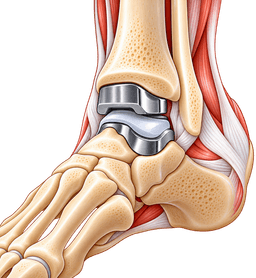
The ankle joint is formed where the lower end of the shin bone, the tibia, meets the talus, the bone that sits on the heel. Both surfaces are covered with smooth cartilage. When this cartilage wears away, bone rubs on bone, causing pain, swelling and stiffness. Total ankle replacement covers the bone ends with metal and places a plastic spacer between them.
The implant has three main parts: a tibial component fixed into the shin bone, a talar component capping the talus and a polyethylene insert that glides between them. Together they act as a new joint surface that moves like the original and carries body weight.
What problems does total ankle replacement treat?
The main target is arthritis of the ankle, described on our ankle osteoarthritis page. This may follow an old fracture or repeated sprains, or it may arise from inflammatory arthritis such as rheumatoid disease. The typical picture is deep pain at the front of the ankle, stiffness, swelling and difficulty with hills, stairs and uneven ground.
It is not intended for mild arthritis that responds to insoles, bracing and activity change. Replacement is reserved for end-stage disease where pain restricts daily life and the joint surfaces are badly damaged on X-ray.
How does total ankle replacement work?
The surgeon exposes the joint, removes a few millimetres of bone and cartilage from the tibia and talus with precise cutting guides, and presses the implant components into the prepared surfaces. The new surfaces replace the damaged ones, so the ankle bears weight on smooth material rather than on raw bone.
Balance of the ligaments and the alignment of the heel are as important as the implant itself. A well-balanced ankle sits straight under the leg, and extra procedures may be done at the same time to correct tilt or tight muscles. These steps greatly influence how long the implant lasts.
Is total ankle replacement major surgery?
Yes. It is a major joint operation, comparable in seriousness to a knee replacement, though usually with a smaller recovery burden. It involves cutting bone, implanting hardware and protecting a repair of soft tissues. Most patients need 2 nights in hospital and months of rehabilitation.
Because the ankle is a smaller joint with thinner skin, wound healing and careful alignment require extra attention. This is one reason that experience and case volume matter more for ankle replacement than for hips or knees.
How does total ankle replacement compare with ankle fusion?
Ankle fusion joins the tibia and talus into one block and removes the painful joint. It is very reliable for pain and lasts many years, but the ankle no longer bends, so the joints in the foot take more strain over time. Replacement keeps movement and a more natural walking pattern.
The trade-off is that an implant has a finite life and may need revision or conversion to fusion later. Our ankle fusion page explains the other path in detail, and many patients discuss both before choosing.
How common is it and who has it?
Ankle arthritis is less common than hip or knee arthritis, and most cases follow injury rather than ageing alone. People who need replacement are often in their 50s to 70s, with a history of a previous fracture or ligament injury many years earlier. Total ankle replacement is performed far less often than hip or knee surgery, so it is concentrated in specialist units.
What are the main benefits and trade-offs?
Benefits include meaningful pain relief, preserved ankle motion, a more natural gait and, for many, a return to walking, gardening, swimming and cycling. Trade-offs include a long recovery, risk of wound trouble, possible need for later revision and restrictions on very high-impact sport such as running on hard surfaces.
Patients who accept these trade-offs and have realistic goals do best. The aim is a comfortable, functional ankle for daily life, not a return to the demands of a young athlete.
Who should think twice about replacement?
People with active infection, poor skin or circulation, uncontrolled diabetes, severe nerve loss, very weak bone or a badly crooked and unstable ankle should discuss alternatives. Heavy smokers and those with very high-impact work also face higher failure rates. Young, very active patients are often steered toward fusion.
A fresh ankle fracture or an acute injury is not a replacement problem and needs urgent local care. Treatment abroad is intended for stable patients with planned operations. Read our total ankle replacement in turkey page, and visit the foot and ankle hub for related topics.
Conditions treated
Who it's for
- End-stage ankle osteoarthritis with severe pain, stiffness and loss of joint space on weight-bearing X-rays, which has not settled with 6 months or more of non-surgical care.
- Post-traumatic arthritis following an old ankle fracture or repeated ligament injuries, with a reasonably straight ankle and healthy bone.
- Inflammatory arthritis, such as rheumatoid arthritis, affecting the ankle in a person whose other joints are also painful and who would struggle with a fused ankle.
- Arthritis in an adult who has already had a fusion on the other side or in nearby joints, and who wants to preserve motion in this ankle.
- Pain that restricts walking distance, stairs, work or sleep and that does not respond to injections, bracing or insoles.
- Stiffness and arthritis in both ankles, where replacing one or both may allow better overall function than two fusions.
- Arthritis in the ankle combined with adjacent hindfoot arthritis, where a replacement plus selective fusion is considered.
- A failed ankle fusion, painful non-union or poor result of earlier surgery in carefully selected patients.
Good candidates
The best candidate for total ankle replacement is an adult with end-stage ankle arthritis, good bone quality, healthy skin and blood supply, a reasonably straight ankle and a moderate activity level who understands the recovery. Selection matters more than technique alone, and surgeons often turn down candidates who would be better served by fusion.
Who is a good candidate for total ankle replacement?
Good candidates have pain that limits life, imaging that shows severe joint damage, and a ligament structure that can keep the ankle stable. They are generally over 50, of moderate weight, and have tried bracing, shoe changes and injections. They are motivated to follow weight-bearing rules and attend physiotherapy.
People with inflammatory arthritis or with arthritis in neighbouring joints may especially value the motion that a replacement preserves. Individual circumstances, such as job demands and hobbies, shape the decision.
Who is not a good candidate?
Active infection, severe vascular disease, Charcot joint disease, severe bone loss in the talus, uncorrectable deformity and significant ligament instability usually argue against replacement. Smoking, obesity and diabetes with nerve damage raise the risk of failure and may need to be addressed first.
Very young or very active patients, and people who plan to run or play impact sport, may do better with fusion or a joint-preserving procedure. Surgeons discuss these limits openly, so ask for a clear explanation of why replacement is or is not suited to you.
How is the decision made?
The surgeon studies standing X-rays of the ankle and foot, often with hindfoot alignment views, and examines your gait, motion and stability. A CT scan or an MRI may show bone cysts, bone loss and the state of the ligaments. The surgeon also checks the calf, the heel and the other foot joints.
If the ankle is tilted, extra procedures may be proposed. A remote review through our medical record review guide can help you compare plans from more than one surgeon.
| Situation | Replacement likely appropriate | Non-surgical care first | Fusion or other plan |
|---|---|---|---|
| End-stage arthritis, straight ankle, good bone | Yes | Already tried | Alternative if you prefer durability |
| Moderate arthritis with preserved joint space | No | Yes: bracing, injections, insoles | Arthroscopy for selected cases |
| Large tilt or unstable ligaments | Only with extra corrective procedures | Brace | Fusion often preferred |
| Heavy manual or high-impact lifestyle | Case by case | Activity change | Fusion may last longer |
| Active infection, ulcer, poor circulation | Not now | Treat first | Yes, after control |
| Severe bone loss or Charcot joint | Rarely | Brace | Fusion or reconstruction |
Weight, bone density and activity goals also influence whether replacement is chosen over fusion. A frank talk about your expectations improves the fit.
Before surgery
Preparation for total ankle replacement means detailed imaging, checking skin, bone and general health, stopping nicotine, correcting anaemia or diabetes and arranging your home for a period without weight. Careful planning improves wound healing and implant positioning, both of which affect how long the replacement lasts.
Which tests and scans are needed before total ankle replacement?
Standing X-rays of the ankle, foot and hindfoot show joint space, alignment and the tilt of the ankle. A CT scan measures bone shape and cysts. Some units use weight-bearing CT, which shows the bones as they sit under load. An MRI may be used to examine ligaments and tendons.
The planning images help the surgeon size the implant and decide whether extra procedures are needed. In some systems, the scans are used to make patient-specific cutting guides before the operation.
What medical checks and optimisation come first?
You will have blood tests, a heart tracing for older adults, a medicines review and screening for infection, including any dental or skin problems. Vitamin D, bone density and blood sugar levels are often checked. Anaemia is treated, and rheumatoid arthritis drugs are managed in consultation with your rheumatologist.
Stop smoking and nicotine at least 6 weeks before and until healing is complete. Weight loss, where appropriate, reduces load on the implant. Skin over the front of the ankle must be healthy and free of rashes, wounds and fungal infection.
How should I prepare my home and work?
Plan to keep weight off the ankle for 2 to 6 weeks, depending on your surgeon's protocol. Arrange a knee scooter, crutches or a walker, a shower stool, a bed or recliner at ground level and help with meals and chores. Practise using aids before surgery.
Desk workers often resume at 3 to 4 weeks with the leg elevated. Jobs that involve standing, walking or ladders usually need 3 to 4 months. Our surgery day guide provides a practical checklist for the day itself.
What should I send for a remote review?
Send standing X-rays as image files, CT or MRI studies, any previous operation notes, a list of medicines and allergies and your history of injuries, injections and bracing. Add photographs of both ankles from the front and from behind, standing. A surgeon can then judge suitability and suggest a plan.
The quote request asks for these items, and the treatment planning guide shows how information turns into an itinerary. Expect a video call before you commit.
What do I pack and what happens before the operation?
Pack loose trousers, a supportive shoe for the other foot, your medicines list and scan files. You will stop eating about 6 to 8 hours before and drink clear fluids until a set time. You may shower with antiseptic soap, and the leg is shaved only if needed. You will sign the consent form after the surgeon answers your questions.
How the operation is performed
Total ankle replacement is done under general or spinal anaesthesia with a nerve block and takes about 120 minutes. The surgeon opens the front of the ankle, cuts matched surfaces from the tibia and talus, balances the ligaments, tests the trial implants and fixes the final components before closing the wound.
How is the operation set up?
You lie on your back with a cushion under the hip. Antibiotics are given before the incision, and a thigh tourniquet helps control bleeding. The leg is cleaned and draped, and imaging is set up so the surgeon can check position at every step.
A nerve block gives long-lasting numbness in the leg. This lowers early pain and the need for strong painkillers. Compression boots on the other leg protect against clots during surgery.
What are the main steps of total ankle replacement?
The steps differ slightly between systems, but most follow this order.
- Make a straight incision at the front of the ankle and carefully protect the tendons, nerves and blood vessels.
- Open the joint capsule and remove bony spurs so that the true joint line is clear.
- Fix a cutting guide to the tibia and make precise cuts to remove the damaged surface.
- Prepare the talus with a second guide, matching rotation and alignment to the shin bone.
- Insert trial components, check the gap, the balance of the ligaments and the range of movement.
- Lengthen a tight calf or release or tighten ligaments, and add a heel bone cut if the heel is tilted.
- Insert the final implants, usually with a press fit, add the polyethylene spacer and check imaging in two planes.
- Close the capsule and skin in layers, apply a padded splint and take the tourniquet off.
Why are ligament balancing and alignment so important?
An ankle that is tilted to one side, or a ligament that is too tight or too loose, loads the plastic spacer unevenly and speeds up wear. Surgeons therefore often add procedures such as a calcaneal osteotomy to realign the heel, a deltoid release or a lateral ligament reconstruction to stabilise the ankle.
These steps lengthen the operation and the recovery but are central to a lasting result. Ask which extra procedures are planned for you and why.
Which total ankle replacement designs are compared?
| Design | Features | Typically chosen when |
|---|---|---|
| Fixed-bearing, two-component | Plastic spacer locks into the tibial piece | Many modern systems, simple mechanics |
| Mobile-bearing, three-component | Spacer glides between tibial and talar pieces | Surgeon preference, to reduce stress at the interfaces |
| Anterior approach | Straight incision on the front of the ankle | Most systems |
| Lateral transfibular approach | Side approach, fibula cut and fixed afterwards | Specific implant designs and some revisions |
| Patient-specific guides | Cutting blocks planned on CT | Complex anatomy, surgeon preference |
| Revision or custom implants | Larger stems or augments | Failed replacement, bone loss |
What extra procedures are often added during the operation?
A replacement rarely stands alone. The calf muscles are often tight in a stiff arthritic ankle, so a small release of the gastrocnemius or a lengthening of the Achilles tendon lets the foot rise to a right angle. Without it, the new joint is held in a pushed-down position and the front of the implant is overloaded.
If the heel tilts inward, the surgeon may slide the heel bone sideways with a calcaneal osteotomy so that body weight falls through the middle of the implant. Large bone cysts are packed with graft, and a damaged outer ligament may be tightened with sutures or a tendon graft. Each of these steps adds time and sometimes extends the period without weight.
Fusion of a neighbouring joint, such as the one between the talus and the navicular, is occasionally done in the same session when it is also arthritic. This decision is made before surgery, so you should know the plan in advance.
How long does total ankle replacement take?
Total ankle replacement usually takes about 120 minutes from anaesthesia to the last dressing. Simple cases may be nearer 90 minutes, whereas cases with extra osteotomies or ligament work often take 3 hours. A longer time does not mean a worse result; it reflects the extra steps needed for a stable ankle.
How is the wound closed and protected?
Skin on the front of the ankle is delicate, so the surgeon closes in layers with fine sutures and uses a padded splint with the ankle at a right angle. No weight goes through the foot at first. Wound care in the first 2 weeks is a major factor in avoiding infection, so keep it dry and elevated.
Hospital stay
Most people stay 2 nights after total ankle replacement. The stay focuses on pain control, wound checks, learning to move without weight and preparing for home. Discharge depends on controlled pain, a dry dressing, safe use of your aids and a clear understanding of the rules for the next weeks.
What happens on the day of surgery?
You arrive fasted, meet the surgeon and anaesthetist and have the correct leg marked. After about 120 minutes in theatre you wake in recovery with a splint and a numb leg. Nurses check your toes for warmth, colour and movement, and the foot is raised on pillows.
Eating and drinking restart when you feel ready, and many people sleep deeply that evening. A urinary catheter is not usually needed, and drains are used only occasionally.
How is pain managed?
The nerve block works for 12 to 24 hours, so tablets begin before it wears off. A common plan includes regular paracetamol, an anti-inflammatory if safe and a short course of stronger medicine. Elevation above heart level and ice around the splint are as important as tablets.
Tell the team about pain that climbs despite medicines, a tight splint, spreading numbness or pins and needles that do not improve.
How do you get moving?
A physiotherapist teaches you to transfer, use crutches or a scooter and manage stairs without weight on the operated leg. Hip and knee exercises start early, and you may be given a clot-prevention injection or tablet. You are encouraged to move the toes and to wiggle the foot gently inside the splint if allowed.
When can you go home?
Most people leave after 2 nights, once pain is under control with tablets, the dressing is dry, the toes are warm and you are safe on your aids. You receive written instructions, a medication plan, a contact number and a date for the first dressing and X-ray check at about 2 weeks.
What does wound care involve?
Wound healing is the key short-term concern. Keep the splint dry and the leg raised, avoid soaking, and report fever, spreading redness, discharge, a bad smell or a wound that gapes. Do not apply creams to the wound unless instructed. Stitches are usually removed at 2 weeks.
What should international patients know?
Plan for 10 to 14 days in the treatment city so that the first wound check, X-ray and splint change are done by the operating team. Flying home is then possible with the leg elevated, an aisle seat and clot precautions. Arrange a companion and ground-floor accommodation if possible.
See our travel and accommodation guide, hospital admission guide and flying after surgery guide for details, and compare centres in our hospital directory.
Recovery
Recovery after total ankle replacement is staged. Expect about 2 to 6 weeks without weight on the ankle, a boot for several more weeks, physiotherapy from about 6 weeks and around 16 weeks until walking feels comfortable and strong. Swelling and strength continue to improve for up to a year.
What is the total ankle replacement recovery time?
The total ankle replacement recovery time varies with the implant, your surgeon's protocol and any extra procedures. Many people wear a splint or cast for 2 weeks, a boot for the following 4 to 6 weeks and are walking in a shoe by about 12 weeks. Most reach good function by about 16 weeks and continue improving to 12 months.
If a bone cut or ligament reconstruction was added, weight-bearing is usually delayed and the timetable stretches. Your surgeon will confirm milestones with X-rays rather than the calendar alone.
What is normal pain, swelling and stiffness?
Pain peaks in the first few days and then falls steadily with tablets, elevation and rest. Swelling is the main limit to comfort and may last 6 months or longer, particularly after long days on your feet. The ankle will feel stiff at first, and range of movement returns with exercise.
The skin around the scar may feel numb or sensitive, which usually improves. Warmth, spreading redness or discharge should be reported at once. A hot, swollen calf needs urgent assessment, as it may be a clot.
What happens at 2, 6 and 12 weeks?
At about 2 weeks the wound is checked, stitches are removed and the splint is changed to a boot or cast. At about 6 weeks X-rays confirm implant position, and weight-bearing in a boot usually starts or increases. By 12 weeks most people are in a shoe, walking with little or no support and working on stairs and balance.
| Time after surgery | Weight on the ankle | Support | Usual activity |
|---|---|---|---|
| 0 to 2 weeks | None | Splint | Rest, elevation, moving toes |
| 2 to 6 weeks | None to partial, per surgeon | Boot or cast | Gentle range of motion if allowed |
| 6 to 12 weeks | Progressing to full | Boot, then shoe | Physiotherapy, walking drills |
| 3 to 4 months | Full | Supportive shoe | Walking, cycling, swimming, strength work |
| 6 to 12 months | Full | Normal shoes | Low-impact sport, gardening, golf, hiking |
What does physiotherapy involve after total ankle replacement?
Early work protects the wound while keeping the hip, knee and core strong. Once the surgeon allows movement, a physiotherapist guides gentle up-and-down ankle motion, calf stretching and balance training. The goals are a good range of dorsiflexion, which is lifting the foot toward the shin, and a smooth, symmetrical walking pattern.
Exercises include seated heel slides, towel stretches, step-ups and later calf raises. Our rehabilitation guide explains how to carry on at home, and the follow-up after returning home guide covers reviews on your return.
When can I drive, work, fly and exercise?
After right-ankle surgery driving usually waits until you are out of the boot and can brake firmly, often 8 to 12 weeks. Desk work may resume at 3 to 4 weeks with the leg raised. Standing jobs wait 3 to 4 months, and heavy labour 4 to 6 months or more.
Low-impact sport such as swimming, cycling, golf and walking is encouraged from about 3 to 4 months. High-impact sport, running and jumping are generally discouraged, because they speed up wear of the implant.
Which symptoms need urgent attention?
Contact the surgical team for fever, spreading redness, wound discharge, a wound that opens, severe or rising pain, a swollen tender calf, chest pain, breathlessness or toes that turn pale, blue or cold. Do not wait for the next appointment. If you are abroad, use local emergency care and tell your surgeon.
Recovery timeline
- Rest and protect the wound1Rest and protect the wound
Days 0–3
Stay in hospital or a nearby hotel with the leg raised above heart level. Take tablets early, before the nerve block fades, and move only for the toilet with crutches or a scooter. No weight goes through the foot. Keep the splint dry and watch toe colour and warmth.
- Settle the swelling2Settle the swelling
Days 4–14
Continue elevation for most of the day, with short moves every hour. Pain eases, but the leg swells when you sit upright. Clot prevention continues as advised. At about 10 to 14 days the wound is checked, the stitches are removed and a boot or cast replaces the splint.
- Protect the implant and bone3Protect the implant and bone
Weeks 2–6
Remain non-weight-bearing or follow the partial plan set by your surgeon. Start gentle range of motion if allowed. Exercise the hip, knee and core. Seated desk work can resume. At about 6 weeks X-rays show the implant position and early bone growth into it.
- Start loading and moving4Start loading and moving
Weeks 6–12
Weight-bearing in a boot increases step by step. Physiotherapy builds ankle motion, calf flexibility and balance. You move from the boot to a supportive shoe as the surgeon allows. Swelling is common at the end of the day.
- Walk with confidence5Walk with confidence
Months 3–4
Most people walk without aids, manage stairs and may drive. Strength work includes calf raises and single-leg balance. Light work and longer walks are comfortable, and cycling or swimming can begin.
- Build strength and endurance6Build strength and endurance
Months 4–6
Function improves steadily, though the ankle may still feel stiff in the morning. Gardening, golf and hiking can be reintroduced with moderation. The surgeon checks X-rays to confirm that the implant is stable.
- Final gains7Final gains
Months 6–12
Swelling settles, scar sensitivity fades and strength approaches its plateau at about 12 months. Annual or two-yearly X-ray reviews begin to check for wear or loosening. Heavy impact activities remain discouraged for the life of the implant.
Outcomes and success rates
Most people who have total ankle replacement report a large reduction in pain and better walking, and the majority of well-selected patients are satisfied. Success means a comfortable ankle that moves and bears weight in daily life, not a return to the demands of a young athlete. Implant survival is long for many, but not unlimited.
What does a good result look like?
A good result is an ankle that is largely free of the deep pain you had, bends through a useful range and lets you walk for a longer distance on level ground and stairs. Many people take up swimming, cycling and walking again, and a smooth gait is a hallmark of success. Some stiffness or occasional aching remains.
Replacement rarely restores the full range of a healthy ankle. The practical gain is comfort and function, and the scar and any swelling fade over months.
What is the total ankle replacement success rate?
Studies suggest that modern implants survive 10 years or more in a large majority of patients, and that pain and function improve markedly in most. Survival figures differ between designs and between registries, so be cautious about one number and ask your surgeon about results with the specific implant they use.
The total ankle replacement success rate is higher when the patient is well selected, the implant is accurately placed and the ankle is stable. It is lower in heavy, very active patients, in those with severe deformity and in smokers.
What factors improve or worsen results?
| Factor | Tends to improve results | Tends to worsen results |
|---|---|---|
| Alignment | Straight heel and balanced ligaments | Residual tilt or instability |
| Bone quality | Good bone with healthy talus | Cysts, osteoporosis, avascular necrosis |
| Body weight and activity | Moderate weight and low-impact life | High weight, running and jumping |
| Nicotine and health | Non-smoker, controlled diabetes | Smoking, poor circulation, neuropathy |
| Surgeon experience | High-volume ankle team | Occasional ankle replacement surgeon |
| Rehabilitation | Adherence to protocol, regular review | Early overload, missed follow-up |
How long does an ankle replacement last?
Many implants last 10 years or more, and some remain functional for 15 to 20 years, but they are not permanent. Wear of the plastic spacer, loosening of the metal parts and bone cysts can develop over time. Regular X-rays allow problems to be caught early, sometimes before symptoms appear.
If an implant fails, options include replacing the spacer, revising the components or converting to fusion. Revision is a bigger operation than the first, so its likelihood is part of the initial conversation.
When is revision or another operation needed?
Revision may be needed for loosening, persistent pain, infection, fracture around the implant, instability or progressive deformity. Smaller operations, such as arthroscopic clean-out of scar tissue or removal of bone spurs, are sometimes done to improve motion. If you have an earlier ankle operation, send the notes with your enquiry.
Implants and technology
Total ankle replacement uses cobalt-chrome or titanium metal components and a polyethylene spacer, with cutting guides and live X-ray imaging to place them accurately. Some systems add CT-based patient-specific guides or three-dimensional planning, while robotics remains experimental. The surgeon's judgement about alignment and balance still matters most.
Which implants are used for ankle joint replacement?
Modern ankle implants have a metal tibial tray, a metal talar dome and a polyethylene bearing. Fixed-bearing designs lock the plastic to the tibial part, while mobile-bearing designs let it glide. Surfaces may be coated with a porous layer or hydroxyapatite so that bone grows into the metal, giving long-term fixation without cement.
Different systems have different footprints and cutting methods. Surgeons usually use one or two systems regularly, and choose by anatomy and by their own experience and results.
How does planning technology help?
Weight-bearing CT scans give a three-dimensional picture of the ankle under load, which helps the surgeon see subtle misalignment and bone cysts. Patient-specific cutting guides, made from CT or MRI, translate the plan into the operating room. Their benefit in outcome is still being studied, but they may shorten surgery and help in unusual anatomy.
What is intraoperative imaging used for?
A mobile X-ray unit, called a C-arm, confirms the cutting guide position, rotation, implant size and the relationship of the parts before the surgeon commits to the final components. Checking from the front and the side prevents errors of tilt and depth. Some centres use a fluoroscopic stress test to check ligament stability.
Are bone graft and cement used?
Cement is not routinely used, because most implants are press-fit. Bone graft or a substitute may fill cysts in the tibia or talus. In revision cases, larger stems, metal augments or custom implants may fill defects. Your surgeon should explain the planned materials and their reasons.
What about robotics and 3D printing?
Robotic systems for ankle replacement are early in development, and routine use is limited. Three-dimensional printed implants and trial components appear in specialist centres for complex cases. These tools are promising, but a long-term track record is the best indicator of reliability, so ask for outcome data.
Risks and how they are managed
All surgery carries risk. Partner hospitals follow enhanced-recovery and infection-prevention protocols, and your surgeon will discuss the risks specific to your case before consent.
- Wound healing problems: the skin at the front of the ankle is thin, so edges may break down or heal slowly. Smoking cessation, gentle handling, elevation and early wound review reduce the risk, and dressings or minor surgery treat problems.
- Infection: deep infection around an implant is rare but serious. Antibiotics before surgery, skin preparation and wound care lower the risk, and treatment may require washout, long antibiotics or implant removal.
- Implant loosening or subsidence: the components may loosen or sink into the bone over time, particularly with cysts or heavy activity. Accurate placement, good bone and moderate activity reduce the chance, and revision is possible.
- Wear of the plastic spacer: polyethylene wears slowly and may need replacement. Balanced alignment and a low-impact lifestyle slow wear, and regular X-rays detect it early.
- Ankle stiffness or instability: the joint may stay stiff, or ligaments may feel loose. Physiotherapy and bracing help, and occasionally further surgery adjusts the balance.
- Malleolar fracture: the bone at the inner or outer ankle can fracture during or after surgery. It is usually fixed with a screw, and healing may extend the recovery.
- Nerve and tendon injury: small nerves and tendons near the incision may be bruised or irritated. Most recover over months, and careful dissection reduces the risk.
- Blood clots: immobilisation raises the risk of clots in the leg. Early movement, compression and blood thinners for those at risk reduce it.
- Bone cysts and osteolysis: gradual bone loss around the implant can occur over years. Imaging surveillance detects it, and treatment ranges from observation to revision.
- Persisting pain: a minority of people still have pain, sometimes from neighbouring foot joints. A careful diagnosis allows targeted treatment, including injections or further surgery.
- Complex regional pain syndrome: a rare condition with burning pain, swelling and skin changes. Early recognition, movement and specialist pain care improve outcomes.
Alternatives
- Bracing, insoles and rocker-sole shoes: they reduce movement and pressure across the painful ankle and are the first option for mild to moderate arthritis or for people who cannot have surgery.
- Activity change and weight management: low-impact exercise and weight loss reduce load on the joint, and they complement every other option.
- Corticosteroid or hyaluronic acid injections: these may bring relief for weeks to months. They are chosen to delay surgery or to confirm that the ankle joint is the source of pain.
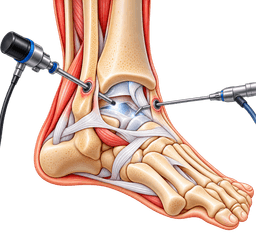
- Ankle arthroscopy: keyhole removal of spurs and inflamed tissue suits early arthritis with impingement but not end-stage joint loss. See our <a href='/procedures/ankle-arthroscopy'>ankle arthroscopy page</a>.
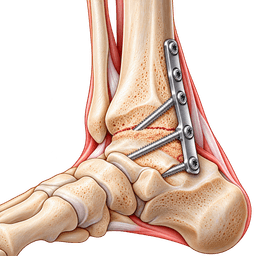
- Ankle fusion: the most common alternative for end-stage arthritis, offering reliable pain relief at the cost of ankle motion. Read about <a href='/procedures/ankle-fusion'>ankle fusion</a> to compare.
- Joint-preserving realignment surgery: osteotomies around the ankle correct tilt and shift load to healthier cartilage. They are used in selected younger patients with partial arthritis.
- Distraction arthroplasty: a frame gently separates the joint surfaces for several months to allow cartilage repair. It is offered in highly selected, younger people and has limited evidence.
- Revision or conversion surgery: for patients with a failed earlier operation, options include re-do replacement or fusion, discussed with a specialist unit.
What total ankle replacement costs
The contracted Turkey partner package next to approved self-pay benchmarks. Benchmarks are 20th–80th percentile ranges of approved records, normalised to USD.
Turkey package
$10,000 – $15,000
United Kingdom self-pay
$15,350 – $33,900
Germany self-pay
$12,450 – $28,050
Typical self-pay range by country
Surgeons who perform total ankle replacement
All surgeonsHospitals offering this procedure
Antalya Yaşam Hospital
Private hospital in Muratpaşa, Antalya, with an orthopedics and traumatology department
BHT Clinic Istanbul Tema Hospital
Large private hospital in Atakent, Küçükçekmece, with an orthopedics and traumatology unit
Biruni University Hospital
University hospital in Küçükçekmece, Istanbul, with a published orthopedics and traumatology department
Çankaya Hospital for Orthopedic Care
Çankaya Hospital for Orthopedic Care is an orthopedic hospital in central Ankara with robotic-arm assisted surgery
Sources and references
Peer-reviewed guidance and institutional sources used to write and review this page.
- 01Orthopaedic treatments
American Academy of Orthopaedic Surgeons (OrthoInfo), 2023
https://orthoinfo.aaos.org/en/treatment/
- 02Ankle Arthritis
American Academy of Orthopaedic Surgeons (OrthoInfo), 2023
https://orthoinfo.aaos.org/en/diseases--conditions/arthritis-of-the-foot-and-ankle/
- 03
- 04Total Ankle Arthroplasty
StatPearls, National Library of Medicine, 2023
https://www.ncbi.nlm.nih.gov/books/NBK541095/
- 05Ankle Arthritis
FootCareMD, American Orthopaedic Foot and Ankle Society, 2023
https://www.footcaremd.org/conditions-treatments
- 06Osteoarthritis
National Institute of Arthritis and Musculoskeletal and Skin Diseases, 2023
https://www.niams.nih.gov/health-topics/osteoarthritis