Key takeaways
- 1Total elbow replacement swaps the damaged joint surfaces of the humerus and ulna for a metal and plastic hinge, which relieves arthritis pain and restores a useful arc of bending when other treatment has failed.
- 2The operation takes about 120 minutes under general anaesthesia with a regional block and usually needs around 2 hospital nights.
- 3Lifelong lifting limits apply: most surgeons advise no more than about 2 kg repeatedly and around 5 kg once, and no pushing up from chairs or using the arm as a hammer, because overloading wears out or loosens the implant.
- 4Recovery takes about 16 weeks for daily use, with a splint for the first 1 to 2 weeks, and the arm keeps improving for several months.
- 5It is mainly chosen for rheumatoid arthritis, severe post-traumatic arthritis and selected broken elbows in older, low-demand adults, and is a poor fit for heavy manual workers or young, very active people.
- 6The main risks are infection, loosening, wear, triceps weakness, nerve problems and fracture around the implant, and implants usually last for years but not forever.
- 7A planned operation can be considered in turkey by stable patients with full records, while a fresh fracture must be treated locally first.
Overview
Total elbow replacement is an operation in which a surgeon removes the damaged ends of the humerus and ulna and fits a two-part metal and plastic hinge. It takes about 120 minutes and usually needs around 2 nights in hospital. The aim is a comfortable, stable elbow for daily tasks. It is an operation of function and not strength, and it brings lifelong lifting restrictions.
That last point deserves honesty from the start. A replaced elbow is built for gentle use, such as eating, dressing and writing. It is not built for lifting furniture or pushing a loaded wheelbarrow.
What is total elbow replacement?
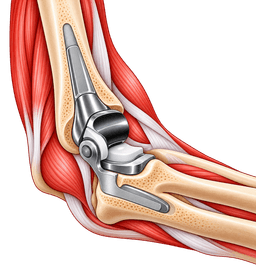
Total elbow replacement, also called elbow arthroplasty or elbow joint replacement, resurfaces both sides of the joint. The lower end of the humerus, the upper arm bone, is shaped like a spool, and the top of the ulna, the forearm bone on the little finger side, wraps around it like a notch. In the operation, a metal stem is cemented into each bone, and the two stems are linked by a hinge pin with plastic bushings in between. The radial head, a small disc on the thumb side, may be left in place or replaced.
What problems does elbow replacement surgery treat?
The main reasons are pain and stiffness from severe arthritis. Rheumatoid arthritis, an inflammatory disease, was historically the commonest cause. Today, post-traumatic arthritis after an old break and the crushed joint of an older person with a fresh fracture are just as important. Primary wear-and-tear arthritis is less frequent in the elbow than in the knee or hip, and it is less often an indication for replacement. See our pages on elbow osteoarthritis and elbow fractures.
How does total elbow replacement work?
The two stems fit inside the hollow centre of the humerus and ulna and are held with bone cement, a fast-setting acrylic. A linking pin allows bending and straightening, while the plastic bushings take the friction. Because the forearm and upper arm are physically connected, the joint does not dislocate easily. The soft tissues around it, mainly the triceps muscle behind and the flexor and extensor muscles at the sides, provide movement.
Is total elbow replacement major surgery?
Yes. It is a big operation on a small, crowded joint. Nerves pass within a few millimetres of the bone, the skin on the back of the elbow is thin and the triceps must be protected and repaired. Surgeons performing it should do so regularly, because experience matters more here than for a hip or knee. The hospital stay is short but the arm needs 4 months to settle.
How common is elbow replacement?
It is much less common than knee or hip replacement, so fewer surgeons do many each year. Rheumatoid arthritis cases have fallen as drug treatment improved, while fracture and post-traumatic cases have risen. Fewer operations mean that the choice of team is especially important.
What are the lifelong lifting restrictions?
Most surgeons advise that, for life, you should not lift more than about 2 kg repeatedly with the operated arm, and no more than about 5 kg in a single lift. You should avoid pushing up from a chair or bed with that arm, and avoid hammering, chopping, pushing a heavy door or doing push-ups. Contact sport and repetitive throwing are out. These limits reduce wear on the bushings and the strain that loosens the stems in the bone.
Why do the limits exist?
The metal and plastic parts are small, and the loads on an elbow are high. A single carry of a shopping bag can place several times its weight across the hinge. Repeated stress rubs the plastic away and pulls on the cement, so the implant can loosen. The restrictions are a trade for pain relief, and most people find the exchange fair once they adapt.
What are the main benefits and trade-offs?
The main benefit is a pain-free or much less painful elbow that moves enough for feeding, hygiene and writing. The trade-offs are the permanent lifting limits, a significant risk of complications compared with a hip or knee, and the chance of a further operation as the implant ages. People who must lift heavy loads for work usually should not choose it unless there is no other way.
How does it differ from related operations?
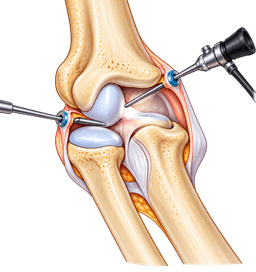
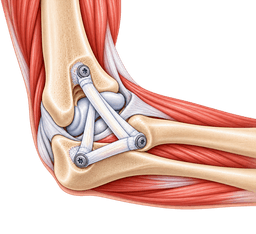
Elbow fracture surgery repairs the patient's own bone and keeps the joint, which is preferred in younger patients. Elbow arthroscopy clears spurs and loose pieces without replacing the joint. Elbow ligament reconstruction rebuilds stabilising ligaments in a joint that is otherwise healthy. Replacement is the choice when the cartilage and bone surfaces themselves are beyond saving.
When must care be local first?
A fresh elbow break, with deformity, a cold or numb hand or an open wound, needs urgent local care. Some older patients with a shattered elbow are treated by primary replacement within days, and that decision belongs to the local trauma team. Treatment abroad is for stable patients with arthritis or follow-on problems, after a medical record review.
See the total elbow replacement in turkey page and the general elbow hub for planning information.
Conditions treated
Who it's for
- Severe rheumatoid arthritis of the elbow with constant pain, stiffness and loss of function despite disease-controlling medicine and injections.
- Post-traumatic arthritis after an old fracture or dislocation, where the joint surface is destroyed and the pain limits dressing, eating or sleep.
- A comminuted distal humerus fracture in an older, low-demand adult that cannot be rebuilt with plates and screws.
- A failed fracture fixation or nonunion in an elderly patient, where the bone is too poor for further repair.
- Primary elbow osteoarthritis that is severe, painful and resistant to clearance surgery or injections, in a low-demand person.
- A stiff or ankylosed elbow (fused or locked) where restoring bending would transform daily tasks, such as reaching the mouth.
- A failed earlier elbow replacement or other implant needing revision, in the hands of an experienced team.
- Tumour or bone loss around the elbow in which a joint implant replaces removed bone, in specialist centres.
Good candidates
A good candidate for total elbow replacement has severe elbow pain or disability from joint destruction, has tried non-surgical care, is not a heavy lifter and agrees to lifelong restrictions. Age is less important than activity level: an inactive 65-year-old is a better candidate than an active 50-year-old, although implants are now used in younger rheumatoid patients too.
Who is a good candidate for total elbow replacement?
People with rheumatoid or post-traumatic arthritis, a low to moderate demand lifestyle, good skin cover over the elbow and a medically fit body. They should be able to follow instructions, attend therapy and accept the limits. A patient with a stiff painful elbow who struggles to feed or wash can gain a lot from a replacement, even when the benefit is mainly comfort.
Who should think twice?
Young, active patients, heavy manual workers, people with active infection, those with severe nerve damage in the arm, poor skin or blood supply, uncontrolled diabetes or those who cannot accept lifting limits. A history of repeated elbow infections is also a warning. In these cases, other options such as clearance, a spacer or fusion-like procedures may be better.
How is the decision made?
The surgeon examines movement, stability, nerve function and the state of the skin. X-rays show joint destruction, and CT may map bone loss. Blood tests look for inflammation and infection. A rheumatologist is often involved, since medicine for rheumatoid disease may need adjustment. The surgeon explains alternatives and the restrictions, and our questions to ask before surgery can help you prepare.
| Situation | Replacement likely appropriate | Other care first | Not advised |
|---|---|---|---|
| Rheumatoid elbow, severe destruction, low demand | Yes | Disease medicine, injections, synovectomy | Waiting until bone is very thin |
| Post-traumatic arthritis, older patient | Yes, if function is poor | Clearance, injections, bracing | If infection is present |
| Comminuted fracture in an older adult | Often, by the local trauma team | Fixation in younger patients | Travel before wound and swelling are controlled |
| Arthritis in a manual worker under 60 | Rarely | Arthroscopic or open clearance, fusion options | Unlimited heavy lifting after surgery |
| Active infection or poor skin | Not until resolved | Antibiotics, wound care | Immediate implant |
If the limits sound too strict for your life, say so before the operation. A frank conversation now is better than a loosened implant later.
Before surgery
Preparation for total elbow replacement focuses on controlling inflammation and infection risk, checking the skin and bone, and arranging life with one limited arm. For arthritis cases it is planned weeks ahead. For a fracture it is compressed into days and handled locally.
Which scans and tests are needed before total elbow replacement?
X-rays from front and side show the joint space and bone quality, and a CT scan maps bone loss and helps size the stems. Blood tests include a count, inflammation markers such as CRP and, for rheumatoid patients, disease activity. A check for hidden infection, for example a dental or skin source, is wise before an implant is placed.
How are medicines managed?
Many rheumatoid medicines affect healing or infection risk. Some are paused for a time around surgery, while steroids are often continued with stress-dose cover. Do not stop anything without the advice of your rheumatologist. Blood thinners and anti-inflammatory tablets are reviewed individually, as are herbal supplements.
Why does the skin matter?
The skin on the back of the elbow is thin, especially after years of steroid treatment or in rheumatoid disease, and wound healing is a main problem. The surgeon checks for scars, nodules, ulcers and infection. A dermatological opinion may be needed, and good nutrition, stopping nicotine and good diabetes control all help the wound.
How do you prepare the home?
You will have an arm in a splint or sling and, long term, a limit on lifting. Move frequently used items to waist height, lighten pans and bags, buy a lightweight kettle and look for long-handled aids. Rearrange the bedroom so you do not push up from the operated side. A raised toilet seat and a sturdy shower chair can help in the first weeks.
What do you send for a remote review?
Share X-rays and CT files, previous operation notes, a medicine list including rheumatology treatment, recent bloods, photographs of the elbow skin and a short video of what you can and cannot do. The process is set out in the medical record review guide, and you can submit records through our quote form.
What should you arrange for work and travel?
Desk work may return at 3 to 6 weeks. Jobs involving repeated lifting may no longer be suitable, so consider a conversation with your employer about changes. Planned travellers should read the treatment planning and travel and accommodation guides, and book a companion.
What should you bring on the day?
Bring your passport, imaging files, medicine list and rheumatology letter, loose tops with wide sleeves, a sling if you have one, and a phone with a long charging cable. Follow fasting instructions, usually 6 hours for food. Wash with the soap that the team gives you the evening before and the morning of surgery, if advised.
How the operation is performed
In total elbow replacement the surgeon exposes the joint, protects the ulnar nerve, removes the damaged bone ends, prepares the canals of the humerus and ulna, cements the two components, links them and repairs the triceps. The operation takes about 120 minutes, and most of the care goes into soft-tissue handling and component alignment.
What anaesthesia is used for total elbow replacement?
General anaesthesia with a regional nerve block is typical. The block gives numbness of the arm for about 12 to 24 hours, which eases the first night. Because many patients are older or have rheumatoid disease, the anaesthetist often checks the neck movement and the heart carefully beforehand.
How are you positioned?
You usually lie on your back with the arm across the chest, or on your side with the arm supported over a pad. A tourniquet on the upper arm limits bleeding. Antibiotics are given in the vein before the first cut, and the skin is cleaned and covered with sterile drapes. Some teams use antibiotic-loaded cement.
What are the key steps in order?
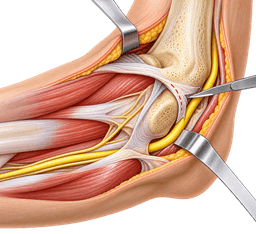
- Cut over the back of the elbow and find and protect the ulnar nerve.
- Reach the joint by detaching, reflecting or splitting the triceps.
- Remove the arthritic bone ends and any spurs, and release tight tissue.
- Shape the canals in the humerus and ulna and try test components for fit and movement.
- Cement the final stems, assemble the hinge and connect the pieces.
- Repair the triceps to the bone with strong sutures through drill holes.
- Move the ulnar nerve forward if needed, close in layers, place a drain and apply a padded splint.
How is the bone prepared and the implant fitted?
Once the joint is open, the surgeon removes the ends of the bones with small saws and burrs, guided by cutting jigs that set the axis of rotation. Reamers and rasps then open the hollow shaft of each bone to the size of the trial stems. The trial pieces are put in, the elbow is moved to check smooth bending, full rotation of the forearm and no catching. Only then is cement mixed.
Each stem is placed while the cement is soft, held steady until it sets, and the excess is cleaned away so that nothing rubs on the nerve. The final parts are joined and the elbow is tested once more.
What is the triceps approach?
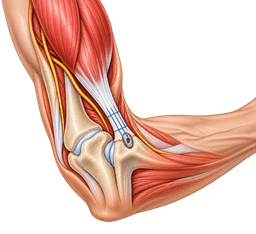
The triceps is the muscle that straightens the elbow. Different approaches sit on a spectrum from splitting it down the middle to lifting it from the bone with a piece of bone attached. After the implant is in, the muscle is reattached. Careful repair is essential, since a detached triceps leaves the arm weak at straightening, and it is the reason you cannot push up with the arm early on.
What types of implant are there?
Linked (semi-constrained) designs have a loose hinge connecting the two stems, which stops dislocation and is the most widely used design. Unlinked (resurfacing) designs depend on your ligaments for stability and are used when ligaments and bone are good. A radial head component is sometimes added. The surgeon chooses according to bone, ligament quality and the cause of the problem.
How do surgeons choose between techniques?
| Option | Best used for | Advantage | Limit |
|---|---|---|---|
| Linked, semi-constrained replacement | Rheumatoid, fracture, post-traumatic arthritis | Stable even if ligaments are weak | Bushing wear over time |
| Unlinked (resurfacing) replacement | Selected arthritis with good ligaments | More natural motion, less stress on stems | Risk of instability |
| Triceps-sparing approach | Good bone, no deformity | Protects the muscle | Harder view of the joint |
| Triceps-reflecting approach | Most primary cases | Good view, reliable repair | Needs a protected repair |
| Distal humeral hemiarthroplasty | Selected fractures in older adults | Replaces only the humeral side | Requires intact ulna surface |
How long does total elbow replacement take?
Typical operating time is about 120 minutes, within a range of 90 to 150 minutes. Complex revisions or cases with bone loss can be longer. How long does total elbow replacement take in all? Allow a day for anaesthesia, surgery, X-rays and recovery, and then about 2 nights in hospital.
What if the bone is weak or missing?
In rheumatoid arthritis or after an old fracture, the bone may be thin or short. The surgeon may choose a shorter stem, add bone graft from the removed bone ends, or use a longer stem for extra support. A tight, stiff elbow is released stage by stage. These extra steps lengthen the operation, which is one reason the planning CT scan matters.
What happens at the end?
The surgeon tests movement by bending and straightening the elbow, confirms that the triceps repair is intact and that the ulnar nerve glides freely. The arm is placed in a padded splint, often with the elbow straight or slightly bent to protect the wound and the triceps. An X-ray confirms component position.
Hospital stay
Most people stay around 2 nights in hospital after total elbow replacement. The first day is spent managing pain, watching the wound and the hand, and starting finger and shoulder movements. Discharge follows when the hand is warm and moving, pain is controlled by tablets and the wound is dry.
What happens on the day of surgery?
After 120 minutes or so in theatre you wake in recovery with a splint and often a numb arm. The nurses check finger colour, warmth and feeling frequently. The arm is raised on pillows. A drain from the wound may stay in for up to 24 hours. You will usually eat and drink later that day.
How is pain managed?
Pain control uses the nerve block, regular paracetamol, a short course of stronger tablets and ice or cold packs. Pain often rises when the block fades during the first night, so take medicine before it goes. Anti-inflammatory tablets may be limited, because of the wound and your other medicines.
When do you start moving?
Fingers, wrist and shoulder move on day 1. A physiotherapist teaches safe dressing and use of a sling. Active elbow movement starts at about 1 to 2 weeks, depending on the triceps repair and the wound. Passive stretching is usually avoided. You will leave with a written list of lifting rules.
What are the discharge criteria?
Typical criteria are stable observations, controlled pain, a warm hand with normal sensation, a dry wound, safe understanding of the sling and the lifting limits, and an X-ray showing good component position. Patients with rheumatoid disease may need a review of their medicines before going home.
How is the wound cared for?
Keep the dressing clean and dry. Stitches or clips are removed at about 2 weeks, and the wound is watched closely, because wound problems are the commonest early complication. Call the same day for redness, discharge, an opening wound, fever or sudden increase in pain.
What do international patients need to know?
Travel is realistic only for stable patients with a planned operation and a controlled wound area. Allow about 7 to 10 days in the country so that the wound check, the first X-ray and the first therapy session take place before you fly. Read the hospital admission, surgery day and flying after surgery guides, and bring a companion. Review hospitals and surgeons before you commit, and check how follow-up and implant records will be handled.
Recovery
Recovery from total elbow replacement takes about 16 weeks for daily use, with strength and confidence improving for 6 months or more. The early priority is to let the triceps and wound heal, and the long-term priority is to keep within the lifting limits for the rest of your life.
What is the total elbow replacement recovery time?
The total elbow replacement recovery time is about 16 weeks to return to ordinary use. Pain eases greatly within 2 to 4 weeks, the splint is off at 1 to 2 weeks and driving is often possible at about 6 to 8 weeks. Work depends on the job: desk work in 3 to 6 weeks, light work in 3 months, and heavy work not at all in some cases. The results continue to improve through months 4 to 6.
How does physiotherapy work?
Therapy starts with protected movement. In the first 6 weeks the aim is active bending and, in some surgeons' protocols, a limit on active straightening against gravity to protect the triceps repair. Then gentle strengthening begins with light bands and hand grip work. A therapist teaches how to do daily tasks within safe limits, for example carrying a cup with the hand low and close to the body.
What do total elbow replacement lifting restrictions mean day to day?
Think in terms of loads and repetition. For life, keep to about 2 kg for repeated lifts and around 5 kg for an occasional single lift, as most surgeons advise, and use the other arm for heavy items. Avoid pushing up from chairs, using the arm as a lever, hammering, golf, tennis, throwing and heavy gardening. Use trolleys, split loads and ask for help. Many people adapt within a few months and find that the rules become habits.
When can you drive, work and exercise?
Driving restarts at about 6 to 8 weeks for most people, once you can control the wheel and the surgeon agrees. Desk work resumes in 3 to 6 weeks. Swimming breast-stroke, walking, cycling on flat ground and gentle gym work using machines with light loads are usually fine at 3 to 4 months. Heavy upper body training is not.
What do 2, 6 and 12 weeks look like?
| Time | What normal healing looks like | Typical activity |
|---|---|---|
| 2 weeks | Wound healed, stitches out, swelling reducing | Splint off, supported movement, light finger use |
| 6 weeks | Triceps healing, movement improving | Daily tasks at waist level, no lifting above a cup |
| 12 weeks | Pain mostly gone, strength starting to return | Driving, light work, lifting up to 2 kg |
How should you care for the implant for life?
Tell any new doctor or dentist that you have an elbow implant. In the past, antibiotics were suggested before some dental procedures for people with joint implants, but advice varies, so ask your surgeon. Treat skin infections promptly, and keep a card with your implant details. Yearly or two-yearly X-rays are often suggested to look for loosening or wear before symptoms arise.
Which symptoms are red flags?
Report a fever, redness, warmth or discharge at the wound, a cold, pale or numb hand, new weakness in straightening the arm, a sudden pop with pain, new tingling in the ring and little fingers, calf pain or breathlessness. Later, new pain after a quiet period or a clunk can signal loosening or a worn bushing.
What helps recovery?
Stop nicotine, keep rheumatoid disease controlled, eat enough protein and sleep with the arm supported. Do your exercises little and often, and do not test the elbow by lifting heavy objects. See the rehabilitation guide and the follow-up after returning home guide.
Recovery timeline
- Rest and wound healing1Rest and wound healing
Days 0–14
The arm is in a padded splint, raised above the heart. Fingers, wrist and shoulder move from day 1. Pain is controlled with tablets while the block fades. Stitches or clips are removed at about 2 weeks. No lifting, pushing or leaning on the elbow.
- Protected movement2Protected movement
Weeks 2–6
A therapist starts active bending, with straightening against gravity limited if the triceps has been repaired. A sling or brace is used for comfort. Daily tasks with the hand near the body are allowed, up to a light cup or phone.
- Regain function3Regain function
Weeks 6–12
Movement continues to improve, gentle strengthening begins and driving is usually allowed at about 6 to 8 weeks. Light desk tasks resume. Lifting remains below 1 to 2 kg, and no pushing up on the arm.
- Return to daily use4Return to daily use
Weeks 12–16
Most people reach comfortable daily use at about 16 weeks. Light household and work tasks are routine. The permanent lifting limits are explained again and confirmed in a clinic visit and X-ray.
- Build confidence and endurance5Build confidence and endurance
Months 4–6
Strength and stamina improve with light exercise. You learn the habits that protect the implant, such as carrying close to the body and using two hands for loads.
- Final improvement6Final improvement
Months 6–12
Pain is typically much reduced and movement is stable. Gains in strength slow down. Follow-up X-rays check the bone and cement around both stems for any early sign of loosening.
- Long-term care7Long-term care
Year 1 onward
Annual or two-yearly checks with X-rays monitor wear and loosening. Keep to the lifelong limits, treat any skin infection promptly and report new pain or clunking early.
Outcomes and success rates
The outcome of total elbow replacement is judged by pain relief, a useful arc of motion and a stable arm that allows daily life. Most people report much less pain and better function, particularly those with rheumatoid disease. Strength improves less than comfort, and the implant has a limited lifespan that is shortened by overloading.
What is the total elbow replacement success rate?
Studies suggest that most patients have good pain relief and function at 5 to 10 years, and many implants last 10 years or more in people who respect the limits. The total elbow replacement success rate is lower than for hip or knee replacement, and complications are more frequent, so numbers are best discussed with the surgeon for your own condition. Results are generally best in rheumatoid patients and low-demand older adults.
What movement can you expect?
A typical result is a functional arc of roughly 30 to 130 degrees of bending, with good forearm rotation, enough to reach the mouth and the back of the head in many cases. Full straightening is not always regained. The goal is to move through the range that daily tasks need, and not to recover a youthful elbow.
What affects the result?
Better results go with accurate component alignment, a well-repaired triceps, controlled inflammation, a non-smoker, an experienced surgeon and adherence to the limits. Worse results go with heavy use, infection, bone loss, nerve damage, poor skin and repeated surgery.
What are the total elbow replacement risks to the outcome?
The total elbow replacement risks that most commonly change an outcome are infection, wound healing trouble, loosening and wear, which are covered in the risk list below. Frank discussion before surgery about these helps patients judge whether the trade is worthwhile.
How long does the implant last?
Most implants function well for 10 years or more, but they are not lifelong, and the bushings can wear sooner with heavy use. Revision surgery is possible, although it is more complex and less predictable than the first operation, so protecting the original implant is the best strategy.
How do patients feel about the result?
Satisfaction is generally high when pain was severe before surgery and expectations were realistic. Dissatisfaction is more common after complications, restricted work or when patients had hoped to return to heavy activity. Setting expectations for life with limits is the best prevention of regret.
When is revision needed?
Revision is considered for loosening, bushing wear, infection, a broken component, fracture around the stems or persistent instability. An infected implant may need a staged procedure with removal and antibiotics. Nerve symptoms around the ulnar nerve can be treated with ulnar nerve decompression in some patients.
How are results monitored?
Expect clinic checks at 2 weeks, 6 weeks, 3 months, 6 months, 12 months and then every 1 to 2 years with X-rays. Keep the implant sticker and operation note. The follow-up guide explains how to share records with a local doctor.
Implants and technology
Total elbow replacement uses a metal-on-plastic hinge made from cobalt-chrome or titanium alloys with polyethylene bushings, fixed by bone cement. Implants vary in design, from linked to unlinked, with stems of different lengths and sizes. Modern instruments help to set the axis of rotation accurately, and no robot or navigation is routine.
What are the components?
The humeral component has a stem that goes into the bone canal and a spool-shaped head. The ulnar component has a stem and a curved bearing surface. A pin or locking mechanism joins them in linked designs, with polyethylene bushings between metal surfaces to reduce friction. Sizes come in a modular range to fit different arms, including small ones typical in rheumatoid patients.
What is bone cement?
Polymethylmethacrylate is the standard cement, a fast-setting acrylic that fills the gap between stem and bone. It is often loaded with an antibiotic to reduce infection risk. Modern cementing technique includes cleaning the canal, using a plug to control the cement and pressurising it, which lowers the risk of loosening.
What is the difference between linked and unlinked designs?
Linked (semi-constrained) designs have a loose hinge between the two parts and are stable even when ligaments are weak. Unlinked designs rely on ligaments and bone for stability and offer a more natural motion but can dislocate. Most surgeons use linked designs for most patients, and choose unlinked ones in good ligament and bone cases.
What other implants exist?
Distal humeral hemiarthroplasty replaces only the humeral side and is used for selected fractures. Radial head implants may be added. Custom implants and bone grafts help with bone loss and revision. Newer coatings and bushing materials aim to reduce wear, but long-term data are still limited, so ask what track record a design has.
What tools help the surgeon?
Instruments such as cutting guides, trial components and intraoperative X-ray help to match the axis of the implant to the natural axis of the arm. CT-based planning is used in complex cases. Navigation and robotics are not standard. For information on facilities, see orthopedics in turkey.
Are implant records important?
Yes. Keep the manufacturer, size and lot number from your operation note or implant card. If you need X-rays, a revision or a new doctor, this information saves time and avoids guessing, particularly if your operation was abroad.
Risks and how they are managed
All surgery carries risk. Partner hospitals follow enhanced-recovery and infection-prevention protocols, and your surgeon will discuss the risks specific to your case before consent.
- Infection: deep infection around the implant is the most feared complication and is higher in rheumatoid patients and with poor skin. Antibiotics, antibiotic cement, careful wound care and skin checks reduce it. Treatment often needs implant removal.
- Aseptic loosening: the stems can loosen from the bone over years, causing pain. Respecting lifting limits and good cementing technique reduce it. Revision surgery may be needed.
- Bushing wear: plastic bushings wear with use, which can cause clunking or instability. Limits on loading slow wear, and bushings can sometimes be exchanged.
- Triceps weakness or detachment: weakness in straightening can follow the approach. Careful repair and early protection reduce it, and re-repair is possible in some cases.
- Wound healing problems: thin skin on the back of the elbow may break down or leak. Skin checks, nutrition and no nicotine reduce it, and a small plastic procedure may be needed.
- Nerve injury: the ulnar nerve is the one most affected, with tingling or weakness in the ring and little fingers. Most cases improve, and the nerve is protected or moved at surgery.
- Fracture around the implant: a bone break can occur during surgery or later from a fall. Technique, bone quality and fall prevention reduce it, and fixation or revision may be needed.
- Instability or dislocation: mostly with unlinked designs or weak soft tissues. Choosing a suitable design and protecting the repair help.
- Stiffness or limited movement: scar and swelling can limit the arc. Early guided movement helps, and a release is rare.
- Blood clots and anaesthetic risks: the risk is low in most patients but higher in older adults with other conditions. Early walking and medication when advised lower clots, and anaesthetic screening reduces other risks.
Alternatives
- Medicine, injections and bracing: used first for arthritis, including disease-controlling drugs for rheumatoid disease. They are chosen when pain is tolerable and the joint is still functional.
- Arthroscopic or open clearance: removes spurs and loose pieces and releases scar, giving relief and movement in earlier arthritis. It is chosen in younger or active patients. See <a href='/procedures/elbow-arthroscopy'>elbow arthroscopy</a>.
- Synovectomy: removing the inflamed lining in rheumatoid disease before the joint is destroyed, sometimes with a radial head excision. It buys time and keeps options open.
- Interposition arthroplasty: placing tissue between the bone ends in younger patients to avoid an implant. Results are less predictable and it may leave the elbow less stable.
- Fracture fixation with plates: rebuilding the distal humerus in younger or active patients. See <a href='/procedures/elbow-fracture-surgery'>elbow fracture surgery</a>.
- Distal humeral hemiarthroplasty: replacing only the humerus in selected fractures when the ulna surface is intact.
- Fusion or leaving a stiff elbow: rarely used, as it removes movement, but sometimes chosen when infection or a heavy job makes an implant unsuitable.
What total elbow replacement costs
The contracted Turkey partner package next to approved self-pay benchmarks. Benchmarks are 20th–80th percentile ranges of approved records, normalised to USD.
Turkey package
$9,500 – $14,500
United States self-pay
$32,850 – $60,200
United Kingdom self-pay
$12,550 – $27,350
Germany self-pay
$11,100 – $24,700
Typical self-pay range by country
Surgeons who perform total elbow replacement
All surgeonsHospitals offering this procedure
Antalya Yaşam Hospital
Private hospital in Muratpaşa, Antalya, with an orthopedics and traumatology department
BHT Clinic Istanbul Tema Hospital
Large private hospital in Atakent, Küçükçekmece, with an orthopedics and traumatology unit
Biruni University Hospital
University hospital in Küçükçekmece, Istanbul, with a published orthopedics and traumatology department
Çankaya Hospital for Orthopedic Care
Çankaya Hospital for Orthopedic Care is an orthopedic hospital in central Ankara with robotic-arm assisted surgery
Sources and references
Peer-reviewed guidance and institutional sources used to write and review this page.
- 01Total Elbow Replacement
American Academy of Orthopaedic Surgeons (OrthoInfo), 2023
https://orthoinfo.aaos.org/en/treatment/total-elbow-replacement/
- 02Elbow Fractures
American Academy of Orthopaedic Surgeons (OrthoInfo), 2023
https://orthoinfo.aaos.org/en/diseases--conditions/elbow-fractures-broken-elbow/
- 03
- 04
- 05Total Elbow Arthroplasty
StatPearls, National Library of Medicine, 2023
https://www.ncbi.nlm.nih.gov/books/NBK560820/
- 06
- 07