Key takeaways
- 1Elbow ligament reconstruction replaces a torn or stretched collateral ligament with a tendon graft threaded through small bone tunnels, so the joint stops giving way.
- 2Two ligaments are involved: the ulnar collateral ligament (UCL) on the inner side, mostly in overhead throwers, and the lateral collateral ligament (LCL) complex on the outer side, mostly after dislocation.
- 3The operation usually takes about 90 minutes under general anaesthesia with a regional block, and most people go home the same day with 0 hospital nights.
- 4Recovery is slow because a graft needs months to mature: around 36 weeks is typical, and return to competitive throwing often takes 9 to 12 months or longer.
- 5A fresh elbow dislocation or a fracture needs urgent local care, and elbow ligament reconstruction abroad suits only stable patients having a planned operation.
- 6Most people regain a stable elbow, but stiffness, ulnar nerve symptoms, graft stretching and a slower return to full sport are the main risks.
- 7Planned elbow ligament reconstruction in turkey can suit well-prepared patients with an MRI and a clear rehabilitation plan, who can stay about 5 to 7 days before flying home.
Overview
Elbow ligament reconstruction is a planned operation that replaces a damaged collateral ligament of the elbow with a tendon graft, so that the joint stays steady under load. Surgeons call the inner version UCL reconstruction and the outer version LCL reconstruction. Surgery takes about 90 minutes, usually as a day case, but the graft needs around 36 weeks to mature before full sport.
The need is often not a single dramatic accident. It can be the result of thousands of throws, or of a dislocation that never quite settled. The first question is always whether a stable elbow can be restored without an operation.
What is elbow ligament reconstruction?
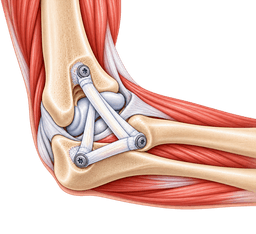
Ligaments are strong bands that tie one bone to another. The elbow has a collateral ligament on each side that stops the forearm bones from sliding sideways as the arm bends. When one fails, the joint wobbles under stress even if the bones look normal on X-ray. Elbow ligament reconstruction builds a new band from the patient's own tendon, or from donor tissue, and anchors it in drilled channels in the bone.
What is the difference between UCL and LCL reconstruction?
UCL reconstruction restores the inner ligament, which resists the valgus force, the stress that pushes the forearm away from the body during an overhead throw. LCL reconstruction restores the outer ligament complex, which stops the elbow rotating out of joint, a problem called posterolateral rotatory instability. The two operations use similar graft techniques but they differ in the position of the tunnels, the side of the incision and the type of patient who needs them.
What problems does elbow ligament reconstruction treat?
It treats chronic elbow looseness that causes pain, a feeling of slipping, clicking or a lack of confidence in the arm. Typical stories are a baseball pitcher whose velocity drops with inner-elbow pain, a gymnast who cannot weight-bear on a hand, or a person with recurrent catching after an old dislocation. The conditions are described on our pages for elbow instability and elbow dislocation.
How does elbow ligament reconstruction work?
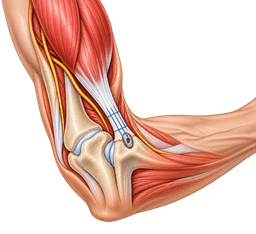
A strip of tendon is taken, most often the palmaris longus from the forearm or a hamstring (gracilis) tendon from the leg, or a donor tendon is used. Small tunnels are drilled where the original ligament attached. The graft is threaded through in a loop or a figure-of-eight and tightened with the elbow in a set position. Over the next months the graft changes from a tendon into a ligament-like tissue.
Is elbow ligament reconstruction major surgery?
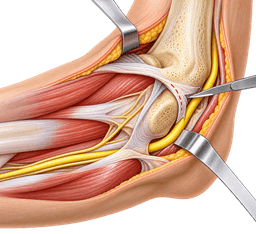
It is a moderate operation done through small incisions and often without a hospital night, but the rehabilitation is long and demanding. The nerves are close: the ulnar nerve lies behind the inner elbow and the radial nerve passes near the outer side. Surgeons identify and protect them. The effort of the operation is small compared with the effort of the following 9 months.
How common is it?
Operations on the inner ligament are mostly performed on young athletes who throw overhead, and numbers have risen over the past decades. Outer ligament reconstructions are less frequent and mostly follow a dislocation or a surgical injury. Most people with a mild ligament sprain never need an operation, which is why careful selection matters.
When is elbow instability surgery chosen over a brace?
Elbow instability surgery is chosen when the elbow keeps slipping or hurting during the activities that matter, after a fair trial of exercises and bracing. A single bad sprain is not enough. Surgeons want evidence from the history, the stress tests and the MRI, and they want the patient to understand that the graft will not work any faster because they are keen. The wish to return to a season date is a poor reason to rush into an operation.
Why not simply repair the ligament?
If a ligament has torn cleanly off the bone in a young person, it can sometimes be repaired with strong sutures and an anchor, with or without suture tape as a reinforcement. If the ligament is stretched, thin or frayed after repeated injury, stitching it back tends not to hold, and a graft is the safer choice. The surgeon makes this decision from the MRI and from what is seen at operation.
What are the benefits and trade-offs?
The benefit is a stable elbow that allows throwing, pushing and daily life without slipping. The trade-offs are a long period away from sport, a second incision for the graft and a small chance of stiffness or nerve irritation. Not every athlete returns to the previous level, and the operation does not prevent later wear in a joint that has been heavily used.
When is urgent care needed?
A freshly dislocated elbow, a deformed joint, a cold or numb hand or an open wound needs an emergency department straight away. A dislocation is reduced, which means put back into place, then splinted and imaged for fractures. Many people recover well without surgery. Planned elbow ligament reconstruction is considered later, if the elbow stays unstable. Abroad treatment is for stable patients only, after a medical record review.
You can read about planning a case on the elbow ligament reconstruction in turkey page and about the wider region on our elbow hub.
Conditions treated
Who it's for
- A complete UCL tear in an overhead thrower with inner elbow pain, loss of control or speed, and a positive stress test that has not improved after about 3 to 6 months of structured rehabilitation.
- Chronic LCL insufficiency with posterolateral rotatory instability, shown by a sense of the elbow slipping when pushing up from a chair.
- Recurrent elbow dislocation or subluxation after an earlier injury, with ligaments that have healed too long.
- A ligament torn at the time of a fracture-dislocation that remains loose after the bone is fixed.
- Instability that appears after earlier elbow surgery, such as a lateral release for tennis elbow that went too far.
- Partial ligament tears in elite athletes where a short non-operative trial has failed and their sport needs a stable joint.
- Instability in a worker or gymnast who loads the arm in push-up positions, where a loose elbow causes pain and apprehension.
- Failed previous ligament repair or reconstruction, in which a revision graft is needed.
Good candidates
A good candidate for elbow ligament reconstruction has a proven, symptomatic instability that interferes with the activity they care about, has tried structured rehabilitation without success, and is ready for a long recovery. Surgeons also look for good general health, a motivated attitude and realistic expectations about return to sport.
Who is a good candidate for elbow ligament reconstruction?
The typical patient is a young or middle-aged athlete with an MRI-confirmed ligament tear and symptoms on throwing, or an adult with a confirmed outer ligament deficiency after a dislocation. These patients usually want to return to overhead sport, racket sport or heavy manual work, and they accept months of exercises. They are non-smokers or willing to stop.
Who should avoid or delay the operation?
A partial tear with good function often settles with rest, bracing and a graded throwing programme, with platelet-rich injections used by some clinicians though evidence is mixed. People with fresh injuries, active skin infection, a stiff joint that has not been mobilised or unrealistic aims should wait. Those with advanced arthritis may be better served by a different procedure.
How is the decision made?
The surgeon takes a history, tests the elbow with gentle stress under X-ray (a valgus stress view) and orders an MRI or a CT arthrogram. For the outer side, they use specific bedside tests such as the pivot-shift test for the elbow. Often the decision is made after a failed trial of rehabilitation. Ask about the graft options and the rehabilitation timeline using our questions to ask before surgery.
| Situation | Surgery likely appropriate | Non-surgical first | Not advised |
|---|---|---|---|
| Complete UCL tear in a competitive pitcher | Yes, UCL reconstruction | 3 to 6 month trial if season allows | Returning to throwing unprotected |
| Partial UCL tear, good function | If rehab fails | Rest, bracing, graded throwing | Early surgery |
| Chronic outer elbow slipping after dislocation | Yes, LCL reconstruction | Bracing and muscle control | Ignoring recurrent episodes |
| Acute dislocation, first episode | Rarely, only with persistent instability | Reduction, short splint, early movement | Routine reconstruction |
| Advanced elbow arthritis | No, other procedures | Medication and therapy | Ligament surgery alone |
If you are not sure which side is involved, the MRI and the stress tests usually answer the question before any plan is made.
Before surgery
Preparation for elbow ligament reconstruction centres on an accurate diagnosis, a strong and mobile arm before surgery, and a plan for the months afterwards. A well-prepared patient who arrives with good movement and clear records usually has a smoother course than one who is stiff and swollen.
Which scans are needed before elbow ligament reconstruction?
X-rays rule out loose bone, arthritis or bone spurs. An MRI, sometimes with contrast injected into the joint (MR arthrogram), shows the ligament and the cartilage. Dynamic ultrasound and stress radiographs can measure how far the joint opens. Bring the image files, not only reports, because surgeons prefer to see the images themselves.
What fitness checks are done?
Standard blood tests and, for older patients, an ECG. The team asks about bleeding tendencies, allergies, previous anaesthetic problems and any use of anabolic steroids or cortisone injections. Injections around the ligament within the previous 3 months can weaken it and may delay surgery.
Why is pre-surgery rehabilitation important?
The elbow should be moving fully before surgery. A therapist can build the strength of the forearm flexor muscles that help protect the inner ligament, improve shoulder and trunk mechanics, and calm any swelling. A stiff elbow before surgery tends to stay stiff afterwards, so range of movement is not negotiable.
How should you look after your general health?
Sleep, protein and vitamin D matter for tendon healing. If you smoke or vape nicotine, stop at least 4 weeks before surgery. Keep training the legs, trunk and the opposite arm so that you do not lose fitness. Tell the team about any recent illness or skin problems around the elbow or the graft site.
Which graft will be used, and how do you prepare for it?
The palmaris longus tendon at the wrist is the usual choice, although it is missing in a minority of people. The surgeon checks for it by asking you to touch your thumb and little finger together and flex the wrist. If it is absent, a hamstring or donor tendon is used instead. Discuss the options, because a leg graft adds a second wound and a few days of leg soreness.
What do you send for a remote review?
Share MRI and X-ray files, previous operation notes, a short video of the instability sign if possible, a list of medicines and a summary of rehabilitation so far. A throwing history, with pitch counts or training loads, helps. The process is described in the medical record review guide, and you can send documents using our quote form.
How do you arrange home and work?
The arm will be in a splint or brace for days to weeks. Stock simple meals, arrange help with driving and prepare for one-handed hygiene. Notify your coach or employer that sport and heavy work are on hold for many months. Decide in advance who will supervise your physiotherapy, because the programme is specific to this operation.
Planned travellers should also read the treatment planning guide and the travel and accommodation guide.
How the operation is performed
Elbow ligament reconstruction uses a tendon graft to rebuild the collateral ligament: the surgeon harvests the graft, drills bone tunnels at the original ligament attachment points, passes and tensions the graft, and closes in layers. Operating time is about 90 minutes. The exact route depends on whether the inner or outer ligament is rebuilt.
What anaesthesia is used for elbow ligament reconstruction?
General anaesthesia with a regional nerve block is typical. The block, placed near the collarbone or armpit, numbs the arm for around 12 to 24 hours, which helps the first night at home. Some patients choose sedation with a block. The anaesthetist reviews fitness and preferences before the day.
How are you positioned?
You lie on your back with the arm on a hand table, or on your side. A tourniquet on the upper arm prevents bleeding in the field. If a hamstring graft is needed, the leg is also prepared. Antibiotics are given before the first cut, and the limb is washed and draped.
How is UCL reconstruction performed?
The surgeon makes a short cut over the inner elbow, splits the forearm flexor muscles along their fibres and finds the damaged ligament. The ulnar nerve is identified and protected, and in some cases moved forward to a new position (ulnar nerve transposition). Tunnels are drilled in the ulna at the sublime tubercle and in the humerus at the medial epicondyle. The graft is passed through the tunnels in a docking or figure-of-eight pattern and tied or fixed with small screws, buttons or suture anchors. In UCL reconstruction, tension is set with the elbow bent to about 30 to 60 degrees.
How is LCL reconstruction performed?
An incision is made over the outer elbow. The remnant of the lateral ligament is found, and tunnels are drilled at the supinator crest of the ulna and at the isometric point on the humerus, where the graft stays at an even length as the elbow bends. The graft is looped through, pulled tight with the forearm rotated and the elbow bent to about 40 degrees, and fixed. The aim of LCL reconstruction is to stop the radial head and ulna from rotating away from the humerus.
What are the key steps in order?
- Harvest the graft from the forearm or leg and prepare it with strong sutures.
- Expose the elbow through the muscles and protect the nerves.
- Drill the tunnels at the ligament footprints and clear debris.
- Pass the graft, set its tension and fix it.
- Test stability with gentle stress under X-ray, and check movement.
- Close the muscle and skin layers and apply a padded splint.
How do surgeons choose between techniques?
| Technique | Used for | Main idea | Trade-off |
|---|---|---|---|
| Docking technique | UCL | Graft ends sit in a humeral tunnel and are tied over a bone bridge | Tight fit but tunnel bridge can break |
| Figure-of-eight graft | UCL | Graft passes through ulna and humerus tunnels and crosses itself | Strong, longer graft needed |
| Suture tape augmentation (internal brace) | Selected UCL tears in young patients | Repair plus a tape that shares the load | Not for stretched or poor tissue |
| Yo-yo or loop with anchor fixation | LCL | Graft loops around the radial neck or fixed in tunnels | Demands careful tension |
| Triceps tendon graft | Revision or LCL | Uses local tendon | Triceps weakness, rare |
How long does elbow ligament reconstruction take?
Operating time is usually 80 to 100 minutes, with 90 minutes as a typical figure. Harvesting the graft takes around 10 to 15 minutes. A revision or a combined repair, for instance with an ulnar nerve transposition or a bone fix, may extend the time to 2 hours. How long does elbow ligament reconstruction take overall? Allow most of a day for preparation, surgery and recovery before leaving.
How is graft tension set?
Tension is one of the finer points of the operation. A graft that is too loose leaves the elbow unstable, and one that is too tight can cost movement. The surgeon cycles the elbow through its arc several times while the graft is held, checks that it moves smoothly and then fixes the final end. For UCL reconstruction, the forearm is held in a slight bend, and for the outer side it is held turned palm-down. Under gentle stress on X-ray, the joint should no longer gape.
What happens at the end?
The surgeon tests stability, checks that the elbow can fully bend and straighten and ensures the ulnar nerve glides freely. A bulky splint holds the elbow at about 90 degrees with the forearm in a set position. X-rays are often taken to confirm the tunnels and any screws.
Hospital stay
Most people go home on the day of elbow ligament reconstruction, with 0 hospital nights, once the arm is warm, pain is controlled and the dressing is dry. Some centres keep patients overnight for observation, especially after a combined procedure or a block that has not worn off.
What happens on the day?
You arrive fasting, have the nerve block placed and go to theatre. After about 90 minutes of surgery you spend an hour or two in recovery. The nurses check finger colour, feeling and movement. A sling and ice help swelling. A physiotherapist teaches you the finger and shoulder movements allowed.
How is pain managed?
Pain is controlled by the regional block and then by regular paracetamol, an anti-inflammatory tablet if it is safe, and a short supply of stronger medicine. Take the tablets before the block fades. The graft site on the forearm or leg may be sorer than the elbow, and ice helps both.
When can you move?
The splint stays on for 1 to 2 weeks, and finger, wrist and shoulder movements start at once. Elbow motion in a hinged brace commonly starts at the first clinic visit, with limits that grow week by week. Your surgeon will specify the range, often 30 to 90 degrees at first.
What are the discharge criteria?
You should be warm and pink to the fingertips, have stable observations, manage pain with tablets, tolerate fluids and understand the sling and wound instructions. You will leave with a written rehabilitation outline and a review appointment in about 10 to 14 days.
How is the wound cared for?
Keep the splint dry. Stitches are removed after about 2 weeks. Watch for redness, discharge or fever. Numbness on the outer forearm near the graft scar is common and normally improves. Avoid driving until you are out of the splint and off strong painkillers.
What should international patients know?
A planned elbow ligament reconstruction travels better than most operations because the stay is short, but the long rehabilitation must be organised before you leave. Allow about 5 to 7 days in the country for the wound check and the first brace adjustments, and arrange a therapist at home who has seen your protocol. Read the hospital admission, surgery day and flying after surgery guides, and consider a companion. Compare hospitals and surgeons before booking.
Recovery
Recovery after elbow ligament reconstruction is measured in months, not weeks: about 36 weeks is the typical figure, and elite throwers often need 12 months or more before competition. The graft is weakest at around 6 to 12 weeks, as it remodels, so patience is the most important part of the rehabilitation.
What is the elbow ligament reconstruction recovery time?
The elbow ligament reconstruction recovery time can be divided into protection (0 to 6 weeks), movement and early strength (6 to 16 weeks), sport-specific work (4 to 9 months) and return to competition (9 to 12 months). Everyday life returns much earlier: desk work in 1 to 2 weeks, driving at about 4 to 6 weeks. The outer ligament operation tends to be a little quicker than the inner ligament in throwers.
What is rehabilitation like?
Rehabilitation follows steps. A hinged brace limits the arc of motion at first. Therapists then restore full extension and flexion, strengthen the forearm, shoulder blade and rotator cuff, and train the legs and trunk, because throwing power starts there. Interval throwing, starting at short distances, usually begins around 4 to 5 months and is progressed over several months.
How is the arm protected after LCL reconstruction?
For LCL reconstruction, the key rule is to avoid pushing up from a chair or bed with the arm and to keep the forearm turned palm-down when bending, which tightens the outer structures. A brace may block the last degrees of straightening for a few weeks. Weight-bearing through the hand starts only when the surgeon says so.
When can you drive, work and play sport?
Many people drive at 4 to 6 weeks, return to desk work in 1 to 2 weeks, and do light manual work at 3 to 4 months. Gym work with light weights begins around 3 months. Throwing and racket sports are staged over 6 to 12 months. A heavy manual job with lifting may need 6 months.
How should the donor site be managed?
The forearm scar may be tender for a few weeks, and the grip feels slightly different at first. A hamstring scar behind the knee can cause thigh soreness for 2 to 3 weeks. Both settle, and strength returns with exercises.
What do 2, 6 and 12 weeks look like?
| Time | What normal healing looks like | Typical activity |
|---|---|---|
| 2 weeks | Wound closed, swelling easing, splint swapped for hinged brace | Gentle bending in a limited arc, finger and shoulder exercises |
| 6 weeks | Near full movement, brace weaned | Light daily tasks, no lifting or throwing |
| 12 weeks | Strength returning, no instability signs | Resistance exercises, driving, start of gym work |
How do you manage sleep, work and mood?
Months of limited sport can be frustrating, especially for athletes who define themselves by training. Short goals help: a range of movement target each fortnight, a strength test each month. Sleep with the arm supported on a pillow for the first 2 to 3 weeks. Many people find that keeping up leg and core training, within limits, helps both fitness and mood.
Which symptoms are red flags?
Seek advice for a fever, discharge or spreading redness, a hand that is cold, pale or numb, increasing pain after the block fades, new tingling in the ring and little fingers, calf pain or sudden loss of range. A pop with sharp pain during rehabilitation should also be reported to the surgeon.
What helps the graft heal?
Stop nicotine, sleep well, eat enough protein and follow the rehab phases without rushing. Avoid taking anti-inflammatory tablets for a long time without advice, and do not go back to throwing because the elbow feels good. Feeling good at 4 months does not mean the graft is mature. Read the rehabilitation guide and the follow-up after returning home guide.
Recovery timeline
- Protect the graft1Protect the graft
Days 0–14
A padded splint holds the elbow at about 90 degrees. Keep the arm raised, move fingers and shoulder, and manage pain with the block and tablets. Stitches come out at about 2 weeks. Do not lift, push up or twist the forearm against resistance.
- Controlled movement2Controlled movement
Weeks 2–6
A hinged brace allows a limited arc, growing from about 30 to 90 degrees and then wider. Therapy restores gentle movement and starts wrist and shoulder strength. Daily activities with the hand at waist level are allowed. No lifting beyond a light cup.
- Full movement, early strength3Full movement, early strength
Weeks 6–12
The brace is weaned and the elbow reaches full movement. Light resistance exercises for forearm and shoulder begin. Driving and routine work are usually fine. Avoid throwing, push-ups or heavy pulling.
- Strengthen and condition4Strengthen and condition
Months 3–4
Strength work progresses to moderate loads. Core, leg and shoulder blade training prepare for the throwing chain. Gym work with controlled weights begins, avoiding painful or stretching positions.
- Interval programme begins5Interval programme begins
Months 4–6
If the elbow is stable, pain-free to touch and strong, a graded throwing or racket programme starts at short distance and low intensity. Each step is repeated without pain before moving on.
- Sport-specific training6Sport-specific training
Months 6–9
Distance, intensity and volume increase under supervision, with rest days built in between sessions. Manual workers return to heavy tasks gradually. Around 36 weeks, most people complete the main rehabilitation phase and have a final strength test.
- Return to competition7Return to competition
Months 9–12 and beyond
Pitchers and similar athletes often need 9 to 12 months or longer, with a final check of strength and mechanics. The graft continues to remodel and strengthen for up to a year.
Outcomes and success rates
The outcome of elbow ligament reconstruction is judged by a stable elbow that allows the activity you wanted without pain or slipping. Most patients get a stable joint, and many athletes return to their sport. Return to the same level depends on the sport, the position, the age and how well the rehabilitation is completed.
What is the elbow ligament reconstruction success rate?
Published series suggest that a majority of athletes return to throwing after UCL reconstruction, with many returning to their previous level of play, though results differ between studies and between positions. For the outer ligament, most patients regain a stable elbow and lose the slipping sensation. The elbow ligament reconstruction success rate should be discussed in the light of your sport and your own scans, not as a single number.
What affects the result?
Better results go with a clear diagnosis, accurate tunnel placement, good graft tension, full movement before surgery, patience in rehabilitation and a sound throwing technique. Worse results link to ongoing instability from other injuries, stiffness, repeated cortisone injections, poor mechanics, restarting sport too early and smoking.
What about the elbow ligament reconstruction risks to the outcome?
Elbow ligament reconstruction risks such as nerve irritation, stiffness and graft stretching explain most disappointing results, and these can be reduced by careful technique and by respecting the timeline. Bone stress injuries in the ulna, which can occur when athletes return quickly, are another factor.
How long do the results last?
A healed graft is generally durable, and many athletes play for years afterwards. However, reconstruction does not make a ligament identical to the original, and repeated high-stress throwing can strain it again. Non-throwers and people with an outer ligament reconstruction usually have a stable elbow for daily life long term.
How do patients feel about the result?
Patients who return to the activity they care about are mostly very satisfied. Those who face a long layoff, a stiff elbow or loss of velocity may be less happy. Setting goals with the surgeon, including the chance of not reaching the same level, helps patients decide.
What will you notice at 6 and 12 months?
At 6 months most people have a stable elbow and good strength, and they are in the middle of a throwing or return-to-sport programme. At 12 months the graft is mature, strength is typically close to the other side, and soreness after heavy use is much reduced. Occasional stiffness after long training days can persist for a year or more and is usually manageable.
When is revision needed?
Revision is considered when the elbow becomes loose again after a re-injury, when a graft has failed to heal, or when poor tunnel position is found. Revision grafts use hamstring, donor or triceps tendon. Results of revision are generally less predictable than those of the first operation. Persistent nerve symptoms may call for ulnar nerve decompression.
How are results monitored?
You will have clinic visits at 2 weeks, 6 weeks, 3 months, 6 months and 12 months, with functional testing at the later visits. Keep your operation note, graft details and rehabilitation protocol. Our follow-up guide explains how remote review works.
Implants and technology
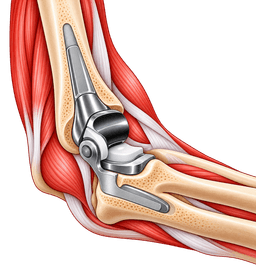
Elbow ligament reconstruction relies on tendon grafts, tiny bone tunnels, strong suture, screws, buttons and anchors, and live X-ray checks to place the graft accurately. No large implant is left behind: the fixation devices are small, and the graft itself is living tissue that becomes the new ligament.
Which grafts are used?
The palmaris longus tendon is the standard choice because it is long, strong enough and not essential to function. A gracilis hamstring tendon is the usual alternative when palmaris is missing or short. Donor tendon (allograft) avoids a second wound but carries a small theoretical risk of slower incorporation. The triceps tendon is used mainly in revisions. A surgeon will explain which graft fits your case.
Which fixation devices are used?
Interference screws wedge the graft inside a tunnel, buttons hold it on the cortex, and suture anchors secure the free ends. Many are made of titanium, polymer or bioabsorbable material. Their job is to hold the graft until it grows into the bone, over about 6 to 12 weeks.
What is suture tape augmentation?
Some surgeons reinforce a repair of a torn ligament with a flat, strong suture tape anchored to the bone. It protects the repair while it heals and may allow earlier movement. It suits selected young patients with a good ligament remnant and is not a replacement for graft surgery in chronic, stretched ligaments. Evidence is still growing.
What imaging helps the surgeon?
An MRI or a joint arthrogram shows the tear, and stress X-rays or ultrasound measure laxity. In the theatre, a mobile X-ray machine confirms tunnel positions and the way the joint opens under gentle stress. Navigation and robots are not standard here because the anatomy is small and directly visible.
Are there biologic add-ons?
Platelet-rich plasma, made from your own blood, is sometimes applied to a graft or a repair. Evidence of benefit in this setting is limited, so it should be viewed as optional and not as a requirement. Ask the surgeon why it is proposed. For hospital details, see orthopedics in turkey.
Can the screws or anchors be removed?
Not usually, and they rarely cause trouble. If a screw or button irritates the skin or the nerve, it can be removed after the graft has healed. Retained implants do not set off airport alarms in most cases.
Risks and how they are managed
All surgery carries risk. Partner hospitals follow enhanced-recovery and infection-prevention protocols, and your surgeon will discuss the risks specific to your case before consent.
- Stiffness: loss of the last degrees of straightening or bending can follow immobilisation. It is limited by early gentle movement and a graded brace, and a release or manipulation is rarely needed.
- Ulnar nerve irritation: tingling or numbness in the ring and little fingers can follow UCL surgery. Most settle in weeks to months, and surgeons may move the nerve forward at the operation.
- Graft failure or stretching: the graft may loosen or tear, particularly if sport restarts too early. Careful tensioning and a staged return reduce the risk, and revision with another graft is an option.
- Infection: deep infection is uncommon. Antibiotics before surgery, clean technique and wound care lower the risk, and treatment may include washout and a course of antibiotics.
- Donor site problems: soreness, scar tenderness or numbness at the forearm or leg wound is common and usually improves. Rarely, a nerve is injured near the scar.
- Fracture or tunnel problems: a bone bridge between tunnels can break, particularly in the humerus or ulna. Good technique and avoiding early loading reduce this, and some cases need fixation.
- Heterotopic ossification or calcification: extra bone may form near the joint. It is rare, but may limit movement and can need removal. Early, gentle movement helps.
- Persistent instability or pain: a missed second injury, poor mechanics or incorrect graft position may leave the elbow loose or sore. Careful diagnosis and rehabilitation lower the chance.
- Blood clots and anaesthetic risk: low in healthy young adults. Walking early and avoiding long immobility reduce clots, and the anaesthetist checks your health beforehand.
- Failure to return to previous level of sport: this is a real risk for high-level throwers, even with a technically good operation. Honest discussion beforehand helps set goals.
Alternatives
- Rest, bracing and rehabilitation: chosen for partial tears or low-demand patients. A structured programme of 3 to 6 months is the first-line option and often works for sprains.
- Activity modification and mechanics coaching: used in throwers with minor strain. Reducing volume, correcting technique and strengthening the shoulder and trunk can unload the elbow.
- Injections such as platelet-rich plasma: tried by some clinicians for partial tears. Evidence is limited and results vary, so they are an option that may or may not help.
- Primary repair with suture tape: considered for a fresh, clean avulsion in a young athlete, as a way to keep the native ligament and allow earlier movement.
- Hinged bracing for outer ligament problems: used for mild or early posterolateral instability or when surgery must wait. It protects the joint but does not cure a failed ligament.
- Reconstruction with a different graft or fixation (revision): chosen if a first reconstruction fails.
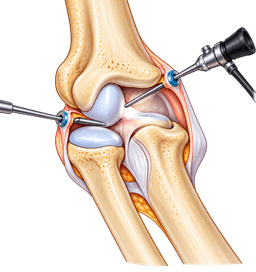
- Arthroscopy for loose bodies or spurs: used when pain comes from impingement or loose pieces rather than from the ligament alone. See <a href='/procedures/elbow-arthroscopy'>elbow arthroscopy</a>.
What UCL / LCL reconstruction costs
The contracted Turkey partner package next to approved self-pay benchmarks. Benchmarks are 20th–80th percentile ranges of approved records, normalised to USD.
Turkey package
$5,000 – $8,000
United States self-pay
$18,200 – $40,400
United Kingdom self-pay
$7,600 – $20,150
Germany self-pay
$6,700 – $18,000
Typical self-pay range by country
Surgeons who perform UCL / LCL reconstruction
All surgeonsHospitals offering this procedure
Antalya Yaşam Hospital
Private hospital in Muratpaşa, Antalya, with an orthopedics and traumatology department
BHT Clinic Istanbul Tema Hospital
Large private hospital in Atakent, Küçükçekmece, with an orthopedics and traumatology unit
Biruni University Hospital
University hospital in Küçükçekmece, Istanbul, with a published orthopedics and traumatology department
Çankaya Hospital for Orthopedic Care
Çankaya Hospital for Orthopedic Care is an orthopedic hospital in central Ankara with robotic-arm assisted surgery
Sources and references
Peer-reviewed guidance and institutional sources used to write and review this page.
- 01Elbow Ligament Injury (Ulnar Collateral Ligament)
American Academy of Orthopaedic Surgeons (OrthoInfo), 2023
https://orthoinfo.aaos.org/en/diseases--conditions/ulnar-collateral-ligament-injuries/
- 02Elbow Dislocation
American Academy of Orthopaedic Surgeons (OrthoInfo), 2023
https://orthoinfo.aaos.org/en/diseases--conditions/elbow-dislocation/
- 03
- 04Ulnar Collateral Ligament Reconstruction
StatPearls, National Library of Medicine, 2023
https://www.ncbi.nlm.nih.gov/books/NBK549997/
- 05Elbow Instability
StatPearls, National Library of Medicine, 2023
https://www.ncbi.nlm.nih.gov/books/NBK541113/
- 06