
Key takeaways
- 1TFCC repair re-attaches a torn triangular fibrocartilage complex, the cushion and ligament on the little-finger side of the wrist, so that the forearm bones stop slipping against each other.
- 2Only some tears are repaired: edge tears with a blood supply can heal, while central tears are usually trimmed rather than sewn.
- 3The operation usually takes about 75 minutes, is done under regional or general anaesthesia and is most often a day case with 0 hospital nights.
- 4A splint or cast limits forearm rotation for about 4 to 6 weeks, and most people need around 12 weeks before the wrist feels dependable for normal tasks.
- 5Ulnar-sided wrist pain, clicking and a feeling of looseness when you turn the forearm are the usual reasons to consider TFCC repair, after rest, splinting and therapy have not helped.
- 6The main TFCC repair risks are stiffness, nerve irritation on the little-finger side, stitch irritation and a repair that does not hold, and careful technique plus strict protection lower them.
- 7Planned TFCC repair in turkey can suit well-prepared patients who send MRI and arthroscopy records and can stay for 7 to 10 days.
Overview
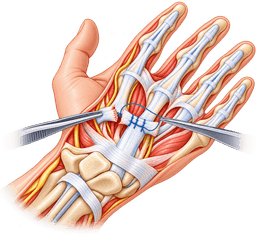
TFCC repair is a wrist operation that sews a torn triangular fibrocartilage complex back to its attachment on the forearm bones. The complex acts as a shock absorber and a stabilising ligament on the little-finger side of the wrist. The surgery usually takes about 75 minutes, is often arthroscopic and most patients go home the same day.
What is TFCC repair?
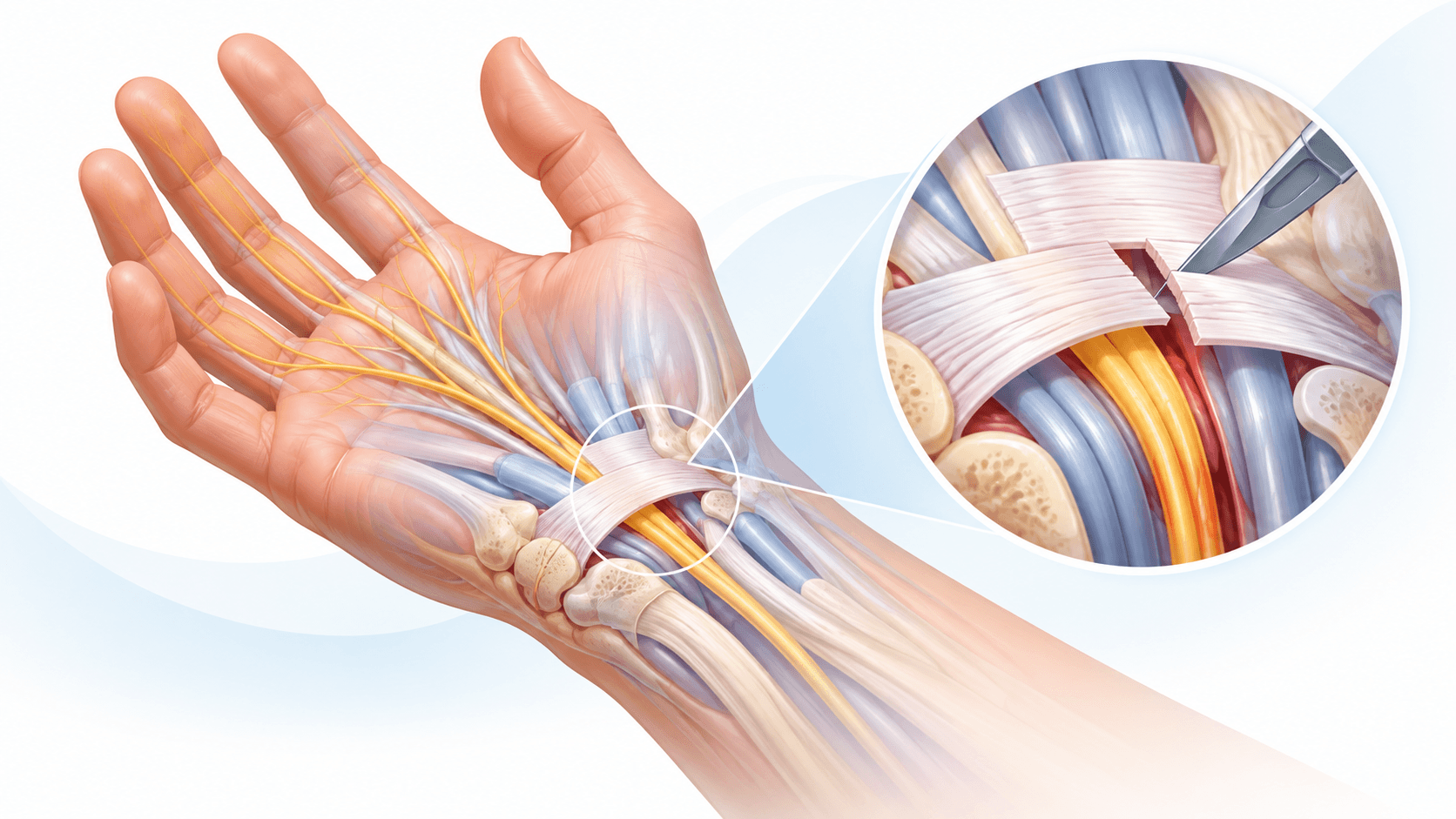
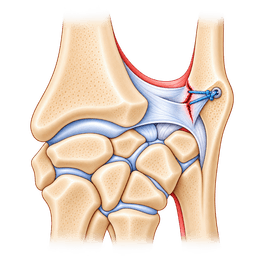
The triangular fibrocartilage complex, or TFCC, is a group of structures: a disc of cartilage, ligaments and a small sheath around a wrist tendon. It sits between the end of the ulna, the forearm bone on the little-finger side, and the carpal bones. It cushions the joint and keeps the radius and ulna together as the forearm turns.
A tear lets those bones shift and rub. TFCC repair uses fine stitches to fix the torn edge back to the capsule or to a small pit on the ulna called the fovea. Our TFCC tear page describes the injury and its causes.
Which TFCC tears can be repaired?
The outer rim of the TFCC has a good blood supply, so torn edges there can heal after stitching. The central disc has almost none. A central tear is usually smoothed with a shaver, a step called TFCC debridement, because stitches would not heal it. Surgeons grade tears as traumatic, from a fall or twist, or degenerative, from wear over years.
What problems does TFCC repair treat?
The operation treats pain on the ulnar side of the wrist, the pinky side, that worsens when you twist, lift or push up from a chair. It also treats clicking, weakness of grip and an unstable feeling at the end of the forearm when the radioulnar joint is loose. Typical stories are a fall on an outstretched hand, a racket-sport twist or a wrist fracture that healed with a hidden tear.
Why does a torn TFCC hurt?
When the cushion tears, the end of the ulna and the carpal bones press on raw tissue and the lining of the joint becomes inflamed. Turning the forearm, as when you open a door handle or wring a cloth, loads the complex the most. That explains why pain often appears with twisting, lifting a heavy pan or pushing off a chair, and fades at rest.
A tear can also change the way the two forearm bones glide. If the deep ligaments holding the ulna are torn, the bone can shift when you rotate, producing a clunk. People describe it as the wrist catching or giving way, and many learn to avoid the movement that triggers it.
How common is a TFCC tear?
Tears are common. Studies of wrist MRI scans find degenerative tears in many people over 50 who have no pain at all. That is why symptoms and examination matter more than the scan alone. Younger, active people, especially gymnasts, tennis players, golfers and workers who grip and twist, tend to present with traumatic tears.
How does TFCC repair work?
The surgeon passes sutures through the torn tissue and anchors them to the capsule or to the bone. Some are placed with a tiny camera inside the joint, others through a small cut over the ulna. Once the stitches hold the tissue against its bed, healing happens over about 6 to 12 weeks, while the splint stops stress on the repair.
Is TFCC repair major surgery?
It is day surgery with small cuts, but the recovery is slower than many people expect. The repair is delicate and the first weeks of protection are strict. Forearm rotation is limited on purpose, which feels awkward. The wrist often needs 3 months before ordinary use, and sport takes longer.
How is it different from other wrist operations?
Wrist arthroscopy is the keyhole technique that TFCC repair often uses, and it can be only diagnostic or combined with trimming. This repair differs from hand and wrist fracture surgery, which fixes broken bones, although a fracture can leave a tear behind. Surgery to shorten the ulna is a related but separate operation.
What are the benefits and trade-offs?
The main benefit is a stable, quieter wrist with less pain on turning the forearm, which many people notice at 3 to 6 months. The trade-offs are weeks in a splint, stiffness while the repair heals, and a small chance that the stitches do not hold. Some tears are better treated with an ulnar shortening osteotomy, so the cause needs to be understood first.
Explore other conditions in hand and wrist care, and see the cost guide for what a planned operation includes.
Conditions treated
Who it's for
- Ulnar-sided wrist pain after a fall or twist that persists after 3 to 6 months of splinting, activity change and hand therapy.
- A peripheral TFCC tear confirmed on MRI or arthroscopy, in a wrist with a stable outer rim of tissue able to hold stitches.
- A tear that detaches the TFCC from the ulnar fovea, causing instability of the distal radioulnar joint.
- Clicking or catching when the forearm is rotated, together with tenderness over the ulnar side of the wrist.
- A positive piano key sign, where the end of the ulna can be pressed down like a piano key because it is loose.
- Persistent weakness of grip or pain when lifting a cup or pushing on a table that is linked to a torn complex.
- A tear found at the time of a wrist fracture repair, such as a distal radius fracture, with continuing instability.
- Athletes in racket, club or bat sports whose wrist cannot take repeated twisting loads.
Good candidates
A good candidate for TFCC repair has ulnar-sided wrist pain and signs of a repairable tear, and has already tried a sensible period of non-surgical care. The tear should be in a place that can heal, and the joint must not have advanced arthritis. Age matters less than the quality of the tissue and your goals.
Who is a good candidate for TFCC repair?
The best candidates are active adults with a traumatic peripheral tear or a foveal detachment. They have local tenderness, pain with forearm rotation and sometimes a loose feel in the joint. They are willing to accept several weeks of immobilisation and to follow a structured therapy programme. Non-smokers heal more reliably, though this is not an absolute rule.
Who should not have a repair?
Repair is generally not advised for central degenerative tears, which are usually trimmed. It is also less suitable where wrist arthritis is advanced, since stitching a tear will not remove pain from worn cartilage; our wrist arthritis page covers that situation. People who cannot protect the wrist for weeks, or who have infection nearby, should delay.
How is the decision made?
Your surgeon will examine the wrist, press on the fovea, test the stability of the radioulnar joint and compare it with the other side. X-rays assess ulnar variance, which is the relative length of the ulna and the radius. MRI, often with contrast, estimates the tear. In many cases, arthroscopy gives the final answer and the repair is done in the same sitting.
| Situation | Repair likely appropriate | Non-surgical first | Other option |
|---|---|---|---|
| Recent traumatic edge tear, unstable joint | Yes, early repair is common | Short splinting if stable | None needed |
| Foveal detachment with loose ulna | Yes, foveal repair | Rarely effective | Reconstruction if tissue is poor |
| Central tear, stable joint | No | Splint, injection, therapy | Debridement |
| Tear with a long ulna | Maybe, with a second procedure | Therapy first | Ulnar shortening |
| Tear with advanced arthritis | No | Pain control | Salvage surgery |
When is care abroad suitable?
TFCC repair is planned surgery, not an emergency, so international care is realistic once you have a clear diagnosis. If the injury is recent and there is also a fracture, local care comes first. Read about treatment planning to see how scans, dates and follow-up fit together.
Before surgery
Preparation for TFCC repair means confirming the exact tear, checking that you are fit for anaesthesia and rehearsing a few weeks of limited forearm turning. Because the first weeks are strict, planning help at home matters as much as the scans. Good preparation also makes a remote second opinion much easier.
Why is a precise diagnosis so important?
Several problems cause ulnar-sided pain, including a tendon sheath irritation, a lunotriquetral ligament tear, arthritis and a long ulna. Treating the wrong one disappoints. Arthroscopy, where the surgeon looks directly into the joint, is the gold standard for confirming a TFCC problem, and many surgeons plan to repair in the same operation if the tear is suitable.
What imaging and tests are needed?
Standard wrist X-rays in a neutral position, with a grip view, measure ulnar variance. An MRI shows the disc and ligaments, and an MR arthrogram, with contrast injected in the joint, improves detection of small tears. A CT can examine the radioulnar joint. Blood tests and an ECG are added if your age or health requires them.
How do I prepare my general health?
Stop smoking and nicotine products, since they slow healing of the repair. Review blood thinners and anti-inflammatories with the team. Control diabetes and treat skin problems on the hand. Tell the team about earlier wrist fractures or surgery, because old hardware or a malunited bone changes the plan.
What should I do about the pain before surgery?
Use a wrist splint at night and during aggravating tasks, take simple painkillers as advised and avoid repeated twisting. Hand therapy to strengthen the muscles that steady the ulna may calm symptoms and prepare the arm. Keep fingers, elbow and shoulder moving so they are not stiff afterwards. Photograph any swelling and record which movements hurt, as it helps the surgeon.
What do I send for a remote review?
Send the MRI images and report, X-rays, any earlier arthroscopy photos, details of injections and therapy you have tried, and a short history of the injury. Add a note on your job and sport. Our guide to a medical record review explains the format, and you can upload files through the quote form.
How do I plan my home and work?
You will wear a splint that limits turning for 4 to 6 weeks. Practise dressing, cooking and washing with one hand before surgery. Arrange help with heavy bags and jars. Desk work may resume in about 1 week, but jobs involving lifting or twisting often need 3 months. Talk to your employer early.
What happens before the operation?
Expect fasting instructions, usually no solid food for 6 hours. The surgeon marks the wrist, and the anaesthetist discusses a nerve block. Remove jewellery from the hand. Bring your scan discs, medicines list and a loose shirt with wide sleeves. Plan transport home with another adult and do not drive.
Which questions should I ask?
Ask whether your tear will be repaired or trimmed, how the stitches are anchored, how long the splint will stay on, who supervises therapy and what happens if the repair fails. The questions to ask before surgery abroad guide offers a checklist. Check the cost guide for what is included.
How the operation is performed
TFCC repair follows a clear sequence: look inside the joint, confirm the tear, prepare the edge, pass stitches and tie them with the wrist in a protected position. Arthroscopic methods dominate, with an open repair kept for some foveal tears. The approach depends on where the tear sits and how well the tissue holds a stitch.
How is anaesthesia given?
Most people have a regional block of the arm, with or without sedation, or a general anaesthetic. A tourniquet on the upper arm keeps the field dry. The hand is hung in a traction tower, fingers held in light finger traps, which opens the space between the bones so the camera can move.
What is the first stage?
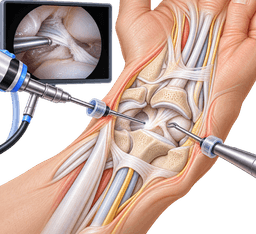
The surgeon makes two or three portals, each about 3 to 5 mm, on the back of the wrist. A camera of about 2.7 mm and fine instruments enter the radiocarpal joint. The surgeon inspects the cartilage, ligaments and the TFCC, then probes the disc. A healthy disc feels taut, like a trampoline. A torn one feels floppy.
How does the surgeon see the tear?
The surgeon first looks at the radiocarpal joint, then at the area between the radius and ulna, called the distal radioulnar joint, sometimes through a separate portal. The probe is used to test tension. A healthy disc bounces back. A torn peripheral rim moves freely. Findings guide the final choice between repair and trimming.
How is the tear prepared?
Scar and frayed tissue are removed with a small shaver so that fresh, bleeding edges can heal. Where a foveal tear exists, the surgeon may check the distal radioulnar joint through a separate portal. Any synovitis, meaning inflamed joint lining, is trimmed. Other injuries found, such as ligament tears, are noted and sometimes treated at the same time.
How is an arthroscopic TFCC repair done?
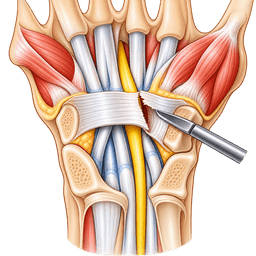
In arthroscopic TFCC repair, a needle carrying a suture passes through the tear and out through the skin. The thread is retrieved, and a second pass makes a loop. The stitch is tied over the capsule, outside the joint, in a small cut near the ulna. Several stitches may be used. The knots are tested and the cartilage edge should sit snug against the capsule.
What is a foveal repair?
For tears pulled off the fovea, a small anchor or a bone tunnel is used to reattach the deep fibres to the ulna. This improves control of the distal radioulnar joint. The anchor is placed through a small cut on the ulnar border. The sutures then pull the tissue back to its footprint, restoring tension in the ligament.
When is open repair used?
Open TFCC repair is a 3 to 4 cm cut on the ulnar side. It is used for large or complex tears, for revision surgery and where the surgeon wants a direct view of the nerve and tendon. The recovery is similar, though the scar is longer and there is a little more risk to the small skin nerve.
What if the ulna is too long?
Some wrists have an ulna that is longer than the radius, known as positive ulnar variance. The extra length squeezes the cartilage disc and wears it, which is why some tears keep coming back. In these wrists the surgeon may cut and shorten the ulna by a few millimetres and fix it with a small plate. This relieves pressure and protects the repair.
The shortening is a second operation done in the same sitting, with a longer recovery of about 3 months for the bone to join. It is not needed in every case, so the plan depends on X-ray measurements and what the camera shows.
How does the operation finish?
The wrist is washed out and the portals are closed with a stitch or a skin strip. A padded splint holds the wrist, often with the forearm in a neutral or slightly supinated position, meaning palm up. Some surgeons add an above-elbow splint to block rotation fully. Final images may be taken.
What are the stitching patterns?
Surgeons use different stitch patterns, such as vertical mattress or horizontal mattress sutures, to pull the torn rim toward the capsule. Each pass of the needle is guided carefully so that it avoids the extensor tendon sheath and the sensory nerve. Tension is set so that the tissue lies flat but is not strangled, a balance that experience provides.
How long does TFCC repair take?
Most operations take about 75 minutes, which includes diagnostic arthroscopy and any added trimming. A simple repair can be shorter, and a combined procedure such as ulnar shortening takes longer. Allow another 3 to 4 hours for anaesthesia, recovery and discharge.
| Method | Best for | Advantages | Drawbacks |
|---|---|---|---|
| Arthroscopic outside-in repair | Peripheral tears | Small cuts, clear view | Technically demanding |
| All-inside suture repair | Peripheral tears with good tissue | Less skin dissection | Needs special devices |
| Foveal anchor repair | Deep tears with a loose ulna | Restores joint stability | Anchor placement is delicate |
| Open repair | Large or revision cases | Direct view | Longer scar, nerve sensitivity |
| Debridement only | Central tears | Faster recovery | Does not restore stability |
How does the surgeon choose between techniques?
The choice depends on tear position, tissue quality, joint stability and surgeon experience. Peripheral edge tears with a stable joint are often handled by suture alone. Loose joints push the plan towards foveal fixation. When the ulna is long and compresses the cartilage, the surgeon may add an ulnar shortening, which is a second operation done in the same sitting.
Hospital stay
TFCC repair is usually a day-case operation, with 0 hospital nights. You arrive 1 to 2 hours before, spend about 75 minutes in theatre and leave once the block is settling and you are comfortable. Stay overnight only if pain is hard to control, if other health issues need monitoring or if travel home is not possible.
What is the plan for the day itself?
Arrive on time with your medicines and scans. A nurse checks your blood pressure and confirms the side of surgery, and the surgeon signs the wrist. The anaesthetist then places the block, which may take 10 to 15 minutes to work. You will probably be awake for it and then sleepy through the operation.
What happens after the operation?
You wake with a padded splint, an arm that feels heavy or numb and a bandage around the wrist. A nurse checks the colour, warmth and movement of the fingers. You are shown how to raise the arm on pillows and how to move the fingers. Light snacks and drinks follow.
How is pain managed?
The nerve block can last 8 to 24 hours, so tablets should start before it fades. Typical plans combine paracetamol, an anti-inflammatory if allowed and a short course of a stronger painkiller. Ice packs over the splint and elevation reduce swelling. Most people find pain peaks in the first 2 to 3 nights.
When can I go home?
You can leave when you are awake, can drink, pass urine, and the fingers are warm, pink and moving. You should have written advice, a prescription and a review appointment. Someone should take you home. Do not drive, sign contracts or use heavy tools for 24 hours after sedation.
How do I look after the wound and splint?
Keep the splint dry and in place. Use a waterproof cover to shower. Do not twist the forearm against it. Move the fingers and the shoulder regularly. Check for swelling, colour and tingling. A splint check at 10 to 14 days is normal, with stitches removed and a more permanent cast or brace applied.
What should international patients plan?
Planned care abroad suits stable patients with a clear diagnosis. Allow 7 to 10 days, covering surgery, a wound review and the start of therapy, and wait for clearance before flying. The guides on flying after surgery and travel and accommodation help you organise this.
Bring your scans and ask for the operation report and arthroscopy photos on disc. A companion helps with luggage and dressing, and the companion guide sets out their role. Review hospital admission and compare accredited hospitals before you choose.
Recovery
Recovery from TFCC repair is a slow staged process: roughly 4 to 6 weeks of protection, then therapy to restore turning and grip, with most people feeling dependable at about 12 weeks. The repair needs time to knit to its bed. Rushing rotation or lifting is the most common way a good operation fails.
How long is the TFCC repair recovery time?
The TFCC repair recovery time is about 12 weeks for daily function and 4 to 6 months for sport and heavy work. The first 4 to 6 weeks are spent in a splint or cast that blocks forearm rotation. Then therapy gradually restores movement, and strengthening starts around week 8 to 10. Some people need longer.
What is the early protection phase like?
You will wear a splint, often above the elbow for the first 2 to 3 weeks so that the forearm cannot turn. Fingers and shoulder should move freely. The hand stays raised. Light typing, using a phone and eating are possible with the other hand. Avoid lifting, pushing up from a chair and twisting jars.
When does rotation therapy start?
Once the surgeon agrees, usually around 4 to 6 weeks, a hand therapist begins gentle forearm rotation and wrist bending. The splint is weaned to a removable brace. Rotation increases in small steps over 2 to 3 weeks. A little soreness is normal. Sharp pain or clicking is a signal to slow down and tell the therapist.
How should I sleep and wash?
Sleep with the arm propped on two pillows, so the hand sits above the heart. Lying on the operated side is unwise at first. Use a waterproof cover for showers and wash the hair with the free hand. Loose tops with wide sleeves are easier than fitted ones, and a sling is only for comfort during travel.
When can I drive?
Many people drive at about 6 to 8 weeks, when the splint is off, rotation is nearly normal and they no longer need strong painkillers. An automatic car is easier. If you cannot turn the wheel quickly without pain, wait. Check insurance terms. Passenger travel has no limits.
When can I return to work?
Desk work can restart in 1 to 2 weeks if the arm stays elevated and the other hand does the typing. Two-handed office tasks follow at around 6 weeks. Jobs with lifting, gripping or vibration usually wait 3 to 4 months. A phased return with light duties works well for many workers.
When can I do sport?
Running and leg work are usually fine within a few weeks, with the arm protected. Racket sports, golf, gymnastics, boxing and weight training that load the wrist should wait for 4 to 6 months, and only after the surgeon confirms stability and strength. A brace may be advised on return.
What does normal healing look like?
| Time | What is normal | Typical activity |
|---|---|---|
| 2 weeks | Pain easing, swelling falling, stitches out | Fingers moving, one-handed tasks |
| 6 weeks | Splint changed to a brace, stiff but improving | Gentle rotation exercises, light daily tasks |
| 12 weeks | Rotation near normal, grip building | Driving, most work, light strength work |
| 6 months | Wrist stable, ache only after heavy use | Sport and heavy lifting |
What symptoms need attention?
Seek advice for fever, a wound that leaks, spreading redness, numbness in the little finger, fingers that turn pale, blue or cold, or severe pain that tablets do not reach. A sudden pop or a sense that the wrist has slipped during therapy also needs review. Do not wait for the next scheduled visit.
Can I fly after surgery?
Short flights are usually possible after about 1 week if the wound is dry and the surgeon agrees. Keep the arm raised and move your fingers on the plane. The follow-up after returning home and rehabilitation guides explain how to continue care.
Recovery timeline
- Rest and elevate1Rest and elevate
Days 0–3
Keep the splint on and the hand above the level of the heart. Take painkillers on schedule while the nerve block fades. Move the fingers and shoulder often. Ice over the splint helps. Do not attempt to turn the forearm. Report colour change, severe pain or tingling that is getting worse.
- Settle the wound2Settle the wound
Days 4–14
Pain eases and strong tablets are usually stopped. Keep elevating. At 10 to 14 days the wound is checked, stitches removed and the splint renewed. Showering with a cover is allowed. Light, one-handed tasks are possible. Do not lift or push through the hand, and avoid twisting in any form.
- Protect the repair3Protect the repair
Weeks 2–4
The wrist remains in a splint or cast, often blocking rotation. Finger exercises continue. Swelling comes and goes. Many people begin desk work with one hand. Keep the wrist away from falls and knocks. The stitches are knitting the tissue to its bed, so patience is important at this stage.
- Start gentle motion4Start gentle motion
Weeks 4–6
A therapist reviews the wrist and the splint is changed to a removable brace in many cases. Gentle wrist bending and forearm rotation begin within a limited range. Scar massage starts once the wound is healed. Heavy lifting is still off limits. Driving usually waits for the next phase.
- Restore movement5Restore movement
Weeks 6–8
Range of rotation increases and the brace is worn mainly for risk situations. Light daily activities, typing and light cooking return. Stiffness at the end of range is common. Strengthening of the forearm muscles begins with light resistance. Report any sharp pain, clicking or feeling that the ulna slips.
- Build strength6Build strength
Weeks 8–12
Grip and forearm strengthening progress, with putty and light weights. Many people drive and return to most work tasks. Push-ups, heavy lifting and racket sport remain restricted. Check-in visits track movement and stability. Mild ache after a busy day is normal.
- Return to sport7Return to sport
Months 3–6
Sport-specific loading is added in stages, from gentle ball work to full swings. A brace may be used on first return. Heavy manual work is cleared when grip reaches near the other side. Persistent clicking, pain or instability is reviewed.
- Final result8Final result
Months 6–12
Strength, movement and comfort plateau. Occasional soreness after heavy use is common and often fades. A final review assesses stability, and imaging is repeated only if symptoms continue. Contact the team if the wrist begins to click or ache again.
Outcomes and success rates
Most people have less ulnar-sided pain and a steadier wrist after TFCC repair, and many return to their usual work and sport within 4 to 6 months. Success means a wrist that is comfortable in daily life, turns well and no longer clicks or gives way. Some people retain mild ache with heavy use.
It is worth separating pain relief from stability. Many people report that pain falls by about half or more, while the wrist is also steadier. A minority continue to feel a small ache that does not stop daily life. Realistic expectations help satisfaction.
What is the TFCC repair success rate?
The TFCC repair success rate is generally good for properly selected peripheral tears. Studies report that most patients get significant pain relief and return to their activities, with satisfaction often described as high. Rates vary by tear type, delay before surgery and technique. A repair that never heals is less common but does occur, so figures from single papers should be read carefully.
Do athletes return to sport?
Many athletes do, usually at around 4 to 6 months, but some find the dominant wrist stays slightly weaker or stiffer than before. Racket and club sports demand repeated rotation and impact, so the return is staged. Studies suggest that earlier repair after injury tends to give better results than long delays.
Most studies on TFCC repair are small or follow patients for a few years, so confident long-term claims are difficult. What is consistent is that pain relief is usual and that the wrist typically becomes more stable. Ask your surgeon how many repairs they do each year and what their own follow-up shows.
What helps the repair heal?
A well-chosen case, stable fixation, strict early protection, not smoking and a supervised therapy plan all help. Treating a long ulna at the same time, where needed, protects the repaired tissue. Patients who follow rotation limits and avoid early lifting tend to do better than those who test the wrist too soon.
How do results differ by tear type?
Traumatic edge tears in younger people usually give the best outcomes, because the tissue is healthy and has a blood supply. Foveal tears also do well when the joint is stable and the repair is secure. Degenerative tears behave differently: trimming or shortening the ulna often matters more than stitching. Chronic tears of long standing recover less reliably and may need a graft.
What can lead to a poorer result?
Degenerative tears with arthritis, poor tissue quality, smoking, missed instability of the radioulnar joint and early overuse are the commonest reasons for poor results. A long ulna that is not treated may keep causing pain. Another injury, such as a hidden ligament tear, can mimic a failed repair.
Will the wrist feel completely normal?
Many people say their wrist feels near-normal in daily life. Some notice a little stiffness at the extreme of rotation, or an ache with heavy loading or cold weather. A small scar on the ulnar side remains, and the portals fade over time. Expectations should be matched to your age and job.
How long does the repair last?
If it heals, the repair is usually permanent. Late problems can arise from a new injury or from wear of the joint over decades. The TFCC is a structure that can retear after a hard fall, as with any ligament, so protection in high-risk sports is sensible.
When is more surgery needed?
A second operation is uncommon. It may be needed if a repair fails, if the ulna is too long and a shortening osteotomy is added, if the radioulnar joint stays loose and needs a ligament reconstruction, or if stiffness requires release. Your surgeon should explain these options beforehand.
Implants and technology
TFCC repair depends on a small camera, fine instruments and sutures, rather than large implants. The key tool is the wrist arthroscope, which lets the surgeon see the cartilage and ligaments on a screen and work through cuts of a few millimetres. Suture technology, anchors and traction towers complete the toolkit.
What is the arthroscope?
A wrist arthroscope is a rod-like camera about 2.7 mm wide, sometimes 1.9 mm for tight joints, attached to a light source and screen. Fluid fills the joint to give a clear view. Magnification lets the surgeon see tears invisible on MRI. A second portal allows probes, shavers and needles to enter the joint.
Which sutures and anchors are used?
Strong braided non-absorbable sutures or slowly absorbable ones are passed through the tissue. Anchors are tiny screw-like or knotless devices, typically a few millimetres wide, made from titanium, PEEK plastic or absorbable materials. They hold sutures in bone at the ulnar fovea. Most remain in place for life and are not felt.
What special instruments help?
Specialised suture passers, curved needles, meniscus-type repair kits adapted to the wrist, and small shavers or burrs prepare and repair the tissue. A traction tower holds the hand with finger traps at a set weight. Some surgeons use a small radiofrequency probe to smooth frayed edges, although this is used with care.
What imaging is used?
Before surgery, MRI and MR arthrography show the tear, and ulnar variance is measured on X-ray. During surgery, fluoroscopy confirms anchor position and, if shortening is added, the bone cuts. Dynamic ultrasound is sometimes used to examine the radioulnar joint, but it is not routine.
Are newer approaches available?
Newer options include all-inside devices, biological augmentation with tendon graft for poor tissue, and 3D planning for reconstruction. Evidence is still developing for some methods. Standard arthroscopic suturing remains the foundation, and what matters most is correct selection of the patient and good technique.
Does technology change the aftercare?
Not very much. Whatever tools are used, the repair still needs weeks of protection. Waterproof splints, adjustable braces and hand therapy apps exist, but the principles of staged motion and strengthening stay the same. Keep to the programme and ask your therapist before changing it.
Risks and how they are managed
All surgery carries risk. Partner hospitals follow enhanced-recovery and infection-prevention protocols, and your surgeon will discuss the risks specific to your case before consent.
- Anaesthesia and general surgical risks: reactions, nausea or chest problems are uncommon, and screening, fasting and early movement of the legs reduce them.
- Infection: a wound or deep infection is rare after keyhole wrist surgery; clean technique and wound care lower the risk, and antibiotics treat it if it occurs.
- Stiffness: the wrist and forearm can lose some rotation, especially after weeks in a splint; supervised therapy restores most motion.
- Ulnar nerve or dorsal sensory branch irritation: numbness or tingling on the little-finger side may follow portals or open repair; most settle within weeks to months.
- Failure of the repair: stitches can pull out or the tissue may not heal, causing persistent pain; strict protection and good case selection reduce it, and revision is possible.
- Stitch or anchor irritation: a knot or anchor may be felt under the skin; this is usually minor and can be treated by removal.
- Persistent instability of the radioulnar joint: some wrists stay loose; foveal repair, ligament reconstruction or other procedures may be needed.
- Tendon problems: the sheath of the ulnar wrist tendon, the extensor carpi ulnaris, can become irritated; therapy, injection or release can help.
- Complex regional pain syndrome: a rare pain disorder with swelling and stiffness; early movement and therapy reduce the chance.
- Scar tenderness: a sensitive scar is common and usually settles with massage over several months.
- Residual pain from arthritis or a long ulna: this can persist when other causes were present; surgeons try to identify them beforehand.
Alternatives
- Rest, splinting and activity change: first-line care for most tears, chosen for a first episode and for stable wrists, usually for 6 to 12 weeks.
- Hand therapy: strengthening of the forearm muscles and training of control, useful for stable tears and as the base of recovery in every case.
- Corticosteroid injection: may calm inflammation and help diagnose the pain source, chosen when pain flares and surgery is not yet planned.
- TFCC debridement: trimming a central tear through the arthroscope, chosen when the tear cannot heal and the joint is stable.
- Ulnar shortening osteotomy: a bone-cutting operation that reduces pressure from a long ulna, chosen for degenerative tears and impaction pain.
- Ligament reconstruction: a tendon graft that replaces tissue that cannot be sewn, chosen for chronic instability.
- Wrist arthroscopy for diagnosis: a look inside the joint when scans are unclear; see <a href='/procedures/wrist-arthroscopy'>wrist arthroscopy</a>.
What Triangular fibrocartilage repair costs
The contracted Turkey partner package next to approved self-pay benchmarks. Benchmarks are 20th–80th percentile ranges of approved records, normalised to USD.
Turkey package
$3,000 – $5,500
United Kingdom self-pay
$4,400 – $13,100
Germany self-pay
$3,550 – $10,850
Typical self-pay range by country
Surgeons who perform Triangular fibrocartilage repair
All surgeonsHospitals offering this procedure
Antalya Yaşam Hospital
Private hospital in Muratpaşa, Antalya, with an orthopedics and traumatology department
BHT Clinic Istanbul Tema Hospital
Large private hospital in Atakent, Küçükçekmece, with an orthopedics and traumatology unit
Biruni University Hospital
University hospital in Küçükçekmece, Istanbul, with a published orthopedics and traumatology department
Çankaya Hospital for Orthopedic Care
Çankaya Hospital for Orthopedic Care is an orthopedic hospital in central Ankara with robotic-arm assisted surgery
Sources and references
Peer-reviewed guidance and institutional sources used to write and review this page.
- 01Triangular Fibrocartilage Complex (TFCC) Tears
American Society for Surgery of the Hand (HandCare), 2023
https://www.assh.org/handcare/condition/tfcc-tears
- 02Wrist Arthroscopy
American Academy of Orthopaedic Surgeons (OrthoInfo), 2023
https://orthoinfo.aaos.org/en/treatment/wrist-arthroscopy/
- 03Wrist Pain
American Academy of Orthopaedic Surgeons (OrthoInfo), 2023
https://orthoinfo.aaos.org/en/diseases--conditions/wrist-pain/
- 04
- 05
- 06Triangular Fibrocartilage Complex Injury
StatPearls, National Library of Medicine, 2023
https://www.ncbi.nlm.nih.gov/books/NBK580516/
- 07