








Key takeaways
- 1Wrist arthritis means loss of the cartilage cushion in one or more of the many small joints of the wrist, which leads to pain, stiffness and a weaker grip.
- 2The most common cause is an old injury, such as a scaphoid fracture that never healed or a torn scapholunate ligament, and the damage can appear 10 to 20 years later.
- 3Osteoarthritis, rheumatoid arthritis, gout and other inflammatory conditions can also attack the wrist, and each one needs a different approach.
- 4Wrist arthritis usually follows a predictable pattern on X-ray, such as SLAC wrist (scapholunate advanced collapse) or SNAC wrist (scaphoid non-union advanced collapse).
- 5Most people start with a wrist splint, activity changes, medicines, hand therapy and sometimes a steroid injection, and many cope well for years.
- 6Surgical options include wrist arthroscopy, denervation, proximal row carpectomy, partial wrist fusion, total wrist fusion and, selectively, wrist replacement.
- 7Wrist arthritis treatment in turkey suits planned, non-urgent surgery after your records are reviewed, and any fresh fracture or sudden hot swollen joint needs local urgent care first.
Overview
What is wrist arthritis?
Wrist arthritis is a long-term wearing or inflammation of the wrist joints, and it can make ordinary tasks such as pushing up from a chair, carrying shopping or typing feel uncomfortable. This page explains why it happens, how the pattern of damage is recognised, and which treatments help, including surgery and care in turkey.
What is wrist arthritis?
The wrist is not a single joint. It is a cluster of about 15 small joints formed by the lower ends of the radius and ulna and the 8 carpal bones. In wrist arthritis, the smooth cartilage covering some of these surfaces thins and breaks down, so bone rubs on bone. The joint lining may swell, and bony spurs may form.
Because the carpal bones work as a team, wear in one spot changes the load on its neighbours. That is why wrist arthritis often spreads in a recognisable order rather than hitting all joints evenly.
Who is affected?
Wrist arthritis can occur at any adult age, but the type differs. People in their 30s to 50s often develop it after an old fracture or ligament injury. Older adults more often have primary osteoarthritis, and inflammatory forms such as rheumatoid arthritis can start earlier. Manual workers, athletes and anyone who has had a significant wrist injury have a higher risk.
Doctors often find wrist arthritis on an X-ray taken for another reason, and the picture does not always match how bad the pain is.
How serious is it?
Wrist arthritis is not dangerous to general health. Even so, the wrist is the platform on which the hand works, so pain and stiffness can limit work and independence. Many people stay comfortable for years with modest measures, and the condition tends to progress slowly.
A sudden, hot, red wrist with fever, or severe pain after a fall, is different. Urgent local care comes first, and travel for treatment is considered only when you are medically stable and your treating team agrees. The sections ahead cover anatomy, causes, patterns, diagnosis, non-surgical care, surgery and recovery.
Anatomy
What happens in the body with wrist arthritis
To make sense of wrist arthritis, it helps to picture the wrist as a set of small stacked bones that slide smoothly over each other. When one link fails, the whole chain is affected.
What is the normal structure of the wrist?
Two main forearm bones reach the wrist. The radius, on the thumb side, forms the main joint surface, with two shallow hollows for the scaphoid and lunate. The ulna, on the little-finger side, sits slightly apart and is cushioned by a cartilage disc (the TFCC).
The carpal bones lie in two rows of 4. The proximal row (scaphoid, lunate, triquetrum and pisiform) connects to the forearm, and the distal row (trapezium, trapezoid, capitate and hamate) connects to the hand. Short, strong ligaments, especially the scapholunate ligament, bind the bones together so that they move as one unit.
How do the joints function?
Movements of the wrist include bending forward and back, tilting side to side, and combined circular movement. Most of the motion occurs at two levels: the radiocarpal joint between the radius and the proximal row, and the midcarpal joint between the two carpal rows. The distal radioulnar joint, a separate joint, allows the forearm to rotate.
What changes with arthritis?
Arthritis begins where cartilage is under the highest load or lowest alignment. After a scapholunate ligament tear, the scaphoid tilts and the capitate sinks into the gap, which wears the radial styloid first, then the scaphoid fossa and the midcarpal joint. The radiolunate joint is usually spared until late.
Fluid builds in the joint, the lining thickens, and bony spurs appear. The capsule stiffens, and the wrist loses motion, first in extension. Nerves and tendons near the joint can become irritated, which can add numbness or tendon pain.
Symptoms & causes
Wrist arthritis symptoms and causes
Common symptoms
- A deep ache across the wrist that builds with use, lifting or weight on the hand, and eases with rest in the early stages.
- Stiffness that limits bending the wrist back (extension) first, which makes pushing up from a chair or doing a push-up painful.
- Swelling or a firm thickening on the back of the wrist, sometimes with a visible bony prominence, particularly after activity.
- Grip weakness that makes it hard to carry shopping, open jars, hold tools or use a steering wheel for long.
- Grinding, clicking or catching sensations when the wrist moves, caused by roughened joint surfaces.
- Morning stiffness lasting from several minutes to an hour, which is longer and more intense in inflammatory arthritis.
- Pain that worsens with weather changes or after a heavy day, and sometimes flares for days after unusual effort.
- Night pain in later stages, making it hard to find a comfortable position for the arm.
- Tingling in the fingers if swelling presses on the median nerve, which suggests associated carpal tunnel syndrome.
- Loss of function in daily activities, such as typing, writing, cooking and sports like tennis or climbing.
Causes and risk factors
- Old ligament injury: a torn scapholunate ligament that is missed or untreated alters wrist mechanics and leads to SLAC wrist over years.
- Scaphoid non-union: a scaphoid fracture that fails to heal causes a predictable pattern of wear called SNAC wrist.
- Distal radius fracture that heals with a step in the joint surface or a tilted position, leading to post-traumatic wear.
- Primary osteoarthritis, which can affect the wrist with age, though it is less common than at the thumb base or fingers.
- Rheumatoid arthritis and other inflammatory conditions, such as psoriatic arthritis, which inflame the joint lining and erode cartilage and bone.
- Crystal arthritis, such as gout or pseudogout (calcium pyrophosphate disease), which can damage cartilage after repeated attacks.
- Kienbock disease, in which the lunate loses blood supply and collapses, changing the load across the wrist.
- Past infection of the joint, or repeated heavy loading in manual work, gymnastics and weightlifting, which may speed up wear.
Types
Types and stages of wrist arthritis
Wrist arthritis is classified by cause and by the pattern of joints involved. The pattern matters, since each stage has its own best operation.
What are the main patterns?
SLAC wrist (scapholunate advanced collapse) follows a long-standing scapholunate ligament injury. SNAC wrist (scaphoid non-union advanced collapse) follows a scaphoid fracture that never healed. Both progress through similar stages. The radiolunate joint is spared until late, which gives surgeons something to work with.
| Stage | Joints affected | Typical features | Common surgical options |
|---|---|---|---|
| Stage 1 | Radial styloid and the tip of the scaphoid | Pain at the thumb side of the wrist with gripping | Arthroscopic styloidectomy, denervation |
| Stage 2 | Whole scaphoid fossa of the radius | Pain, reduced extension, swelling | Scaphoid excision with four-corner fusion, or proximal row carpectomy |
| Stage 3 | Midcarpal joint (capitate and lunate) | Stiffness, grinding, weak grip | Four-corner fusion, or wrist fusion if the capitate is worn |
| Stage 4 | Radiolunate joint and pan-carpal wear | Marked pain, little motion | Total wrist fusion, selected wrist replacement |
How does the cause change the plan?
Osteoarthritis tends to be limited to a few joints and may suit motion-saving surgery. Rheumatoid arthritis affects the whole wrist and often the tendons, so medical treatment of the disease comes first, and surgery is chosen to protect tendons and give a stable, comfortable wrist. Gout and pseudogout need crystal control as well.
Post-traumatic arthritis after a distal radius fracture may be localised to the radius surface, and the fix may be simpler than in a full SLAC pattern. Surgeons also note whether the ulnar side or the distal radioulnar joint is involved.
Why do stage and demand matter?
A 35-year-old labourer and a 70-year-old office worker with the same X-ray may need different operations. Age, hand dominance, the need for strong grip versus motion, and general health all feed into the decision.
Diagnosis
How is wrist arthritis diagnosed?
Wrist arthritis is diagnosed by listening to your history, examining the wrist and confirming with X-rays. Further scans are used to plan treatment rather than to make the diagnosis.
What does the examination include?
The doctor asks about previous injuries, which may go back years, as well as work, hobbies, family history and other joint problems. They compare both wrists for swelling, shape and skin changes, and press along the joint lines to find the tender area. The location of tenderness helps identify which joints are involved.
They measure movement with a goniometer, check grip strength against the other side, and test for ligament looseness. The scaphoid shift test and the pronator quadratus tests are examples, and they feel for clicks, grinding and tendon swelling. Nerve function is checked for carpal tunnel and ulnar nerve signs.
Which imaging is used?
Plain X-rays from several angles are the core test, and standing and clenched-fist views may show a gap between bones. They reveal joint space narrowing, spurs, cysts and the pattern of collapse. CT scans give a 3D view of bone detail and are useful before surgery. MRI shows cartilage, ligaments and blood supply, particularly if Kienbock disease or an occult ligament tear is suspected.
Why is arthroscopy sometimes used?
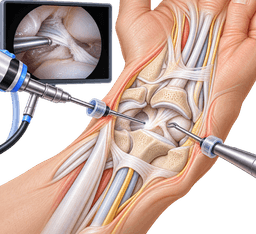
Through 2 or 3 small incisions, a surgeon can inspect the cartilage directly and judge which surfaces are healthy. Wrist arthroscopy can reveal that the radiolunate joint is intact, which would favour a motion-saving operation. It can also treat limited problems at the same time.
What should you bring to a remote review?
- X-ray images (and CT or MRI if done) in DICOM format with the reports
- A timeline of past wrist injuries, fractures or operations
- A list of treatments tried, with dates and results
- Blood test results if inflammatory arthritis or gout is suspected
- Photos of the wrists from above and the side, and a video of wrist movement
The medical record review guide explains how to share this safely.
Tests you may have
- Plain wrist X-rays (PA, lateral, oblique): show joint space narrowing, bone spurs, cysts and the alignment of the carpal bones.
- Clenched-fist and stress views: reveal widening between the scaphoid and lunate that is hidden on a relaxed image.
- CT scan: gives detailed 3D bone images to map worn areas, fracture non-union and cysts before reconstruction or fusion.
- MRI scan: shows cartilage, ligaments and bone blood supply, and helps identify Kienbock disease or early ligament injury.
- Blood tests: rheumatoid factor, anti-CCP antibodies, inflammatory markers and uric acid to look for inflammatory or crystal arthritis.
- Joint aspiration: fluid is drawn from a swollen wrist and examined for crystals and infection, which is vital with a hot joint.
- Ultrasound: detects fluid, lining inflammation and tendon involvement, and may guide injections.
- Diagnostic arthroscopy: direct inspection of the cartilage surfaces, which helps decide between motion-saving surgery and fusion.
Look-alikes
Conditions that can feel like wrist arthritis
Wrist pain has many sources. Some mimic arthritis, and others coexist with it. The table lists the common look-alikes and how doctors separate them.
Which conditions mimic wrist arthritis?
| Look-alike condition | How it differs | How doctors tell |
|---|---|---|
| Wrist sprain or ligament tear | Pain after a specific injury, often with clicking, but with preserved cartilage | X-ray normal or showing a gap; MRI or arthroscopy |
| TFCC tear | Ulnar-sided pain with twisting, usually no joint space loss | Tenderness at the ulnar fovea; MR arthrogram |
| Thumb base arthritis | Pain at the CMC joint, slightly distal to the wrist | Grind test; X-ray of the CMC joint |
| De Quervain's tenosynovitis | Tendon pain at the thumb side, no joint wear | Finkelstein test; ultrasound |
| Ganglion cyst | Smooth lump, often on the back of the wrist, with variable pain | Examination and ultrasound |
| Kienbock disease | Central wrist pain from a collapsing lunate | MRI shows loss of blood supply |
| Carpal tunnel syndrome | Night tingling in thumb, index and middle fingers | Nerve conduction studies; examination |
| Septic arthritis | Hot, red, severely painful joint with fever | Blood tests and joint aspiration; an emergency |
What if several conditions overlap?
Overlap is common. A wrist with an old scaphoid fracture can have arthritis and a ganglion, and rheumatoid disease often brings tendon problems and carpal tunnel together. The surgeon will aim to treat the main pain source and warn you about the others.
A fresh injury on top of chronic arthritis needs imaging, because a new fracture can hide behind long-standing pain. If a fall has changed your symptoms, see our page on hand and wrist fractures and seek assessment promptly.
Non-surgical
Non-surgical treatment for wrist arthritis
Non-surgical treatment is the starting point for wrist arthritis, and it controls symptoms for many people for a long time. It aims to calm the joint, protect it and keep the hand functional.
How do splints and bracing help?
A wrist splint holds the joint in a neutral, comfortable position and limits painful extension. A ready-made support is a good start, and a custom thermoplastic splint from a hand therapist fits better. Many people wear a splint during heavy tasks and at night, and leave it off for light use so that muscles stay strong.
How should you change activities?
Pace tasks, alternate heavy and light jobs, and use both hands where possible. Avoid pushing up with the palm, such as push-ups and handstands, and use forearm or fist positions instead. Use tools with larger handles, wheeled bags, and voice dictation to avoid long typing sessions. Small adjustments often cut pain more than people expect.
Which medicines are used?
Topical anti-inflammatory gels, paracetamol and short courses of oral anti-inflammatory tablets are the standard first choices, depending on your health. In inflammatory arthritis, a rheumatologist may prescribe disease-modifying drugs and biologic therapy, which have changed outcomes for rheumatoid arthritis dramatically. In gout, urate-lowering treatment protects the joint.
Are injections useful?
A corticosteroid injection into the wrist joint can reduce pain and swelling for several weeks to months, and it can show which joint is causing the pain. It is not a repair, and doctors limit repeated injections. Evidence for hyaluronic acid or platelet-rich plasma in the wrist is limited.
What does hand therapy add?
A hand therapist can teach gentle range-of-motion work, strengthening for the forearm muscles that support the wrist, and techniques to share the load across joints. Heat before exercise, and paraffin baths, may ease stiffness. Therapy is useful both before and after surgery.
How long should you try?
Most surgeons expect a trial of at least 3 to 6 months of well-organised non-surgical care before an operation is considered, unless the joint is badly damaged or unstable. If pain still limits work, sleep or hobbies, a hand specialist can discuss the options.
Self-care
Exercises and self-care for wrist arthritis
Daily habits cannot reverse worn cartilage, but they can reduce flare-ups and keep the wrist moving. Always check with your doctor or hand therapist before starting an exercise plan, and stop if you get sharp or lasting pain.
Which exercises are commonly used?
- Wrist flexion and extension: rest the forearm on a table and bend the wrist gently up and down; 10 repetitions, 2 to 3 times a day.
- Prayer stretch: press the palms together at chest height and lower the hands slowly for a gentle stretch; hold 15 seconds.
- Forearm rotation: with the elbow at your side, turn the palm up and down; 10 repetitions.
- Tendon glides: move the fingers through straight, hook, fist and tabletop positions to prevent stiffness.
- Light grip work: squeeze a soft ball for 5 seconds; start with 5 repetitions and build up.
Warm the wrist first with a heat pack or a warm soak for 10 minutes. If a flare follows, reduce the number of repetitions and try again later.
Which habits ease flare-ups?
Keep the wrist neutral when typing, with a soft wrist rest and the keyboard at elbow height. Choose lighter pans and cups, carry bags on the forearm, and use a trolley instead of lifting. Heat soothes stiffness, and cold packs for 10 to 15 minutes can calm a swollen wrist.
What about work and sport?
Discuss adjustments with your employer if your job involves vibration, heavy lifting or repetitive impact. Climbers, racket players and weightlifters may need to modify grip, use wrist wraps and plan rest days. Swimming, walking and cycling with a neutral wrist usually remain comfortable.
What should you avoid?
Avoid prolonged hard gripping, hammering and heavy impact through the palm. Do not stop moving the wrist altogether, since stiffness tends to worsen. Be sceptical about supplements and devices that promise to rebuild cartilage. If you smoke, stopping helps general joint health and surgical safety.
Check with your doctor or physiotherapist before starting new exercises, and stop any movement that causes sharp pain.
Treatment
Wrist arthritis treatment options
Surgery for wrist arthritis aims to relieve pain while keeping as much useful motion and strength as possible. The choice depends on the stage and pattern of arthritis, the health of the remaining joints, your age and your job.
How do the operations compare?
| Operation | What is done | Best suited to | Trade-offs |
|---|---|---|---|
| Arthroscopic debridement or styloidectomy | Loose cartilage and a spur at the radial styloid are removed with a camera | Early, limited disease (stage 1) | Quick recovery; benefit may be temporary |
| Wrist denervation | Small pain nerves to the joint are cut | Painful wrist where motion and strength must be kept | Keeps motion; pain relief is partial and may fade |
| Proximal row carpectomy | The first row of carpal bones is removed | Stage 1 to 2, with healthy capitate cartilage | Keeps about half of motion; not for a worn capitate |
| Scaphoid excision and four-corner fusion | The scaphoid is removed and 4 bones are fused | Stage 2 to 3 with a healthy radiolunate joint | Keeps some motion; needs bone healing; hardware can irritate |
| Total wrist fusion | The radius and carpal bones are fused with a plate | Advanced disease, heavy use, failed earlier surgery | Reliable pain relief and strength; no wrist motion |
| Total wrist replacement | An implant replaces the joint surfaces | Selected low-demand patients, often rheumatoid | Keeps motion; risk of loosening; weight limits |
Where does wrist arthroscopy fit?
Our catalogue lists wrist arthroscopy as the linked procedure for this condition. Keyhole surgery is used to confirm the stage, remove loose fragments, clear spurs and sometimes to carry out part of a reconstruction. For the pathway for international patients, see wrist arthroscopy in turkey, and for the cost structure, visit the wrist arthroscopy cost guide.
What does a proximal row carpectomy involve?
The surgeon removes the scaphoid, lunate and triquetrum through a small cut on the back of the wrist, so the capitate sits in the radius hollow. The operation takes about 60 to 90 minutes. A splint follows for 2 to 4 weeks, and then therapy. It keeps motion and is mechanically simple, but needs healthy cartilage on the capitate head and the radius.
What does wrist fusion involve?
For total wrist fusion, the surgeon removes remaining cartilage, packs bone graft into the joint and fixes the radius to the hand with a plate and screws, with the wrist slightly extended. After bone healing at about 8 to 12 weeks, most people have a pain-free, strong wrist and still rotate the forearm, since the forearm joint is spared.
Which choice suits whom?
Younger patients who need a strong grip may favour partial or total fusion. Patients wanting to keep motion may choose denervation or proximal row carpectomy. In rheumatoid disease, replacement or fusion may be considered, together with medical control. Your surgeon should explain why a given operation suits your pattern.
When surgery is considered
Consider surgery for wrist arthritis when pain or stiffness still limits your life after a fair trial of non-surgical care. The decision is personal, and there is no single scan finding that forces an operation.
When is a specialist review sensible?
- Pain that persists beyond 3 to 6 months of splinting, medicines, therapy and activity change.
- Injections that give shorter and shorter relief.
- Pain at night or at rest that disturbs sleep.
- Progressive loss of motion or grip that threatens your job.
- Rheumatoid arthritis with tendon symptoms or wrist instability.
- An old scaphoid or ligament injury with new pain and collapse on X-ray.
How do you weigh the choices?
Decide what matters most: pain relief, motion or strength. Fusion gives dependable pain relief and strength at the cost of motion. Motion-saving options keep movement, but pain relief may be less complete and revision may be needed later. Replacement keeps motion in the right patient, with its own risks.
Think about your work, hand dominance, hobbies and willingness to accept a recovery of 3 to 6 months. Many people adapt well to a fused wrist, particularly because the other joints of the hand and forearm compensate.
What questions should you ask?
- Which pattern of wrist arthritis do I have, and how healthy is the remaining cartilage?
- Which operation do you recommend and what are the alternatives?
- How many of these operations do you perform each year?
- How much motion and strength will I keep, and when can I work?
- What is the chance that I will need a further operation?
If you want a second view of your scans, request a free case review.
Procedures
Procedures that may treat wrist arthritis
Costs
Wrist arthritis treatment cost in Turkey
| Procedure | Turkey package | US self-pay | Saving |
|---|---|---|---|
| Wrist Arthroscopy | $2,500 – $4,500 | $15,175 | ~77% |
Packages are contracted partner prices with validity dates; benchmarks are source-backed estimates. Open a cost guide for the full country comparison.
In Turkey
Treating wrist arthritis in Turkey
Wrist arthritis treatment in turkey can suit people who need a planned operation such as arthroscopy, denervation, fusion or carpectomy and want a hand surgeon, a defined schedule and clear aftercare. Because the condition is chronic, there is time for careful preparation, which is a major advantage.
When does it make sense to travel?
It may suit you if non-surgical care has not controlled pain, your scans are available, your general health is stable and your local doctor agrees you can travel. It may also help if waiting times at home are long, or if you want an extra opinion between motion-saving surgery and fusion.
It is not for a hot, swollen, feverish wrist, severe pain after a new injury, or a suspected fracture. Those need urgent local care, and travel is considered only once you are stable and your team agrees.
What does the pathway look like?
- Records review: X-rays, CT or MRI, reports and a history go to a hand surgeon.
- Plan: the surgeon describes the likely operation, why it was chosen and which findings might change it.
- Arrival: examination, anaesthetic review and consent 1 day before surgery.
- Surgery: arthroscopy is often a day case, while fusion or carpectomy may need 1 to 2 nights.
- Early review: wound and X-ray check at about 10 to 14 days.
- Aftercare: hand therapy at home with a written plan for your local therapist.
Read our treatment planning guide and hospital admission guide for more.
How do you assess the surgeon and hospital?
Choose a surgeon who focuses on hand and wrist surgery and does reconstructions regularly. Ask about the volume of carpectomies, fusions or arthroscopies, the implants used, and whether results are audited. Confirm hospital accreditation and the presence of a hand therapist. When you ask about wrist arthroscopy for arthritis in turkey, ask also what would make the surgeon change plans during the operation.
What about timing and logistics?
Plan for 5 to 8 days for arthroscopy or denervation, and longer for a fusion with a splint check. A companion is helpful, since one arm will be out of use. Our flying after surgery guide covers flights and swelling. Explore the orthopedic care in turkey overview, and the cities of Istanbul and Ankara.
What are the limits?
Do not travel with infection or uncontrolled inflammatory disease flares. Complex revision surgery or a total wrist replacement with a long follow-up may be safer near home. Wrist arthritis surgery in turkey should include shared records and a plan for your local therapist. See the hand and wrist hub, or start with a free case review.
Complications
Complications of wrist arthritis
Wrist arthritis can limit function over time, and treatment, like all medicine, has risks. A frank discussion helps you choose between options.
What happens if wrist arthritis is left alone?
Many people stay stable for years. In others, the arthritis spreads from the first worn joints to the rest of the wrist, motion falls, and pain at rest or at night appears. Tendons may fray over spurs, and in rheumatoid disease, they can rupture. Daily tasks such as lifting or using tools become harder.
What are the risks of non-surgical care?
- Medicine effects: stomach, kidney and blood pressure problems with oral anti-inflammatories.
- Injection effects: a temporary flare, skin changes and, rarely, infection.
- Splint effects: weakness and stiffness if worn all day for months.
What are the risks of surgery?
Risks include infection, bleeding, stiffness, persistent pain, nerve and tendon injury, and anaesthetic problems. After a fusion, bone may fail to join (non-union), and plates can irritate tendons and need removal. After a carpectomy, motion and strength may be lower than hoped, and arthritis can progress at the new joint.
Wrist replacement can loosen or wear, and may need revision. Denervation may give only partial or temporary relief. Complex regional pain syndrome is a rare complication of any wrist surgery, with pain and swelling out of proportion. Smoking, diabetes and long-term steroids raise the chance of healing problems.
How are risks reduced?
Choose an experienced surgeon, stop smoking well before surgery, control blood sugar and inflammatory disease, and follow the rehabilitation plan. Report fever, spreading redness, drainage, new numbness or a cold hand quickly. Ask which risks apply to your specific operation.
Urgent care
When to seek urgent care for wrist arthritis
- A hot, red, swollen wrist with fever or feeling unwell: seek urgent medical care the same day, since joint infection or a crystal flare needs prompt treatment.
- Severe pain after a fall, with deformity or inability to move the hand: attend an emergency department to exclude a fracture.
- A white, blue or cold hand, or a tight cast with swelling: seek emergency help immediately because circulation may be at risk.
- Sudden inability to straighten a finger or the thumb: see a hand specialist within a day or 2, as a tendon may have ruptured, which happens in some arthritic wrists.
- Fever, pus or spreading redness around a wound or injection site: contact your surgeon or emergency service at once.
- New numbness, constant tingling or weakness in the fingers: arrange a prompt review, because a nerve may be under pressure.
Prevention
How to lower your risk of wrist arthritis
Many forms of wrist arthritis follow injury, so protecting the wrist and treating injuries well are the most practical forms of prevention. Some causes, such as age and genetics, cannot be changed.
How do you protect the wrist after an injury?
Take any wrist injury seriously. A tender wrist after a fall should be assessed for a scaphoid fracture or ligament tear, since missed injuries are the usual root of SLAC and SNAC patterns. Follow-up imaging, correct casting and, when needed, early surgery lower the chance of long-term wear.
Finish the full course of treatment and rehabilitation, even if the wrist feels better. Report any ongoing pain after 2 to 3 weeks, and ask whether a scan is needed.
What reduces strain in sport and work?
- Wear wrist guards for skating, snowboarding and cycling.
- Use correct technique and gradual progression in weightlifting, gymnastics and climbing.
- Use tools that cut vibration, and take regular breaks from repetitive tasks.
- Keep the wrist neutral when typing or using a mouse.
How do you manage inflammatory disease?
Early diagnosis and treatment of rheumatoid arthritis, psoriatic arthritis and gout protect the joints. See a rheumatologist if you have several swollen, stiff joints, morning stiffness over 1 hour or a family history. Modern treatments greatly reduce joint damage when started early.
Which general habits help?
Stay active, keep a healthy weight, stop smoking and keep bones strong with calcium, vitamin D and weight-bearing exercise. A strong forearm and good balance help prevent falls onto the outstretched hand.
What cannot be prevented?
You cannot change your genes, and not every injury can be avoided. Accept that some wear is part of life, and focus on early assessment and sensible care. Neighbouring problems such as Dupuytren's contracture and trigger finger may occur alongside, and each needs a tailored plan.
Outlook
Living with wrist arthritis: outlook and recovery
The outlook for wrist arthritis is usually good for comfort and function with the right plan, even though the joint damage itself does not reverse. Many people keep a useful wrist for decades, and surgery, when needed, gives reliable pain relief.
What is the natural course?
Wrist arthritis tends to progress slowly, over years rather than months. The pattern may stay in an early stage for a long time. Inflammatory forms behave differently and can improve dramatically with modern drug therapy. Symptoms often fluctuate with activity.
What can you expect after surgery?
| Operation | Immobilisation | Return to desk work | Return to heavy use |
|---|---|---|---|
| Arthroscopic debridement | 1 to 2 weeks | 1 to 2 weeks | 6 to 8 weeks |
| Denervation | 1 to 2 weeks | 1 to 3 weeks | 6 to 8 weeks |
| Proximal row carpectomy | 2 to 4 weeks | 3 to 4 weeks | 3 to 4 months |
| Four-corner fusion | 6 to 8 weeks | 3 to 6 weeks | 4 to 6 months |
| Total wrist fusion | 6 to 12 weeks | 4 to 8 weeks | 4 to 6 months |
Most people report significant pain relief after these operations, with some trade-off in motion. A fused wrist is stiff but strong and pain-free for most patients, and the hand adapts. Motion-saving procedures offer movement but may give less complete pain relief.
What about long-term results?
Studies of proximal row carpectomy and four-corner fusion show good pain relief in a majority of selected patients, with some needing conversion to fusion over time. Total wrist fusion has a long track record. Wrist replacement results have improved, but are best in low-demand patients. Discuss realistic expectations with your surgeon.
How can you support recovery?
Attend therapy, protect the wrist as advised, avoid smoking and maintain general fitness. Report new swelling, redness or pain early. To plan next steps, explore the hand and wrist section or send your scans for a free case review. Related reading includes TFCC tear and thumb base arthritis.
Surgeons
Specialists who treat wrist arthritis
FAQ
Wrist arthritis: frequently asked questions
What are the first symptoms of wrist arthritis?
What causes wrist arthritis in a younger person?
What is a SLAC wrist?
Can wrist arthritis be treated without surgery?
What is a proximal row carpectomy?
Will I lose all wrist movement after a wrist fusion?
Is wrist denervation effective?
How long is recovery after wrist arthritis surgery?
Is wrist arthritis treatment in turkey safe?
Who can have wrist arthritis surgery in turkey?
How do I start a review for treatment in turkey?
Does exercise make wrist arthritis worse?
Sources
Sources for this wrist arthritis guide
Peer-reviewed guidance and institutional sources used to write and review this page.
- 01Wrist Arthritis
American Society for Surgery of the Hand, 2023
https://www.assh.org/handcare/condition/wrist-arthritis
- 02Arthritis of the Wrist
American Academy of Orthopaedic Surgeons (OrthoInfo), 2021
https://orthoinfo.aaos.org/en/diseases--conditions/arthritis-of-the-wrist/
- 03Wrist Arthroscopy
American Academy of Orthopaedic Surgeons (OrthoInfo), 2021
https://orthoinfo.aaos.org/en/treatment/wrist-arthroscopy/
- 04
- 05
- 06Arthritis
National Institute of Arthritis and Musculoskeletal and Skin Diseases, 2023
https://www.niams.nih.gov/health-topics/arthritis
- 07Osteoarthritis in over 16s: diagnosis and management (NG226)
NICE, 2022
https://www.nice.org.uk/guidance/ng226
- 08