





Key takeaways
- 1Morton's neuroma is a painful thickening of a nerve between the long bones of the forefoot, usually in the gap between the third and fourth toes.
- 2The classic story is burning or sharp pain in the ball of the foot, tingling in two toes and relief when you take your shoe off and rub the foot.
- 3It is not a cancer: the word neuroma here means a thickened, irritated nerve, and the cause is repeated squeezing of that nerve.
- 4Most people improve with wider shoes, a metatarsal pad, activity changes and sometimes an injection, so surgery is usually a later step.
- 5Diagnosis rests on the story, a squeeze test of the forefoot and often an ultrasound, which can also rule out look-alikes.
- 6If non-surgical care fails after about 3 to 6 months, removing the nerve or releasing the tight ligament around it brings lasting relief for most people.
- 7Morton's neuroma treatment in turkey can suit planned surgery once your history, scans and fitness for anaesthesia have been checked remotely.
Overview
What is Morton's neuroma?
Morton's neuroma is a thickened, irritated nerve in the front of the foot that causes burning pain and tingling around the toes. People often describe it as standing on a folded sock or a pebble. This page explains how it arises, what separates it from other forefoot pain, and how it is treated, including treatment in turkey.
What is Morton's neuroma?
Between each pair of long foot bones (metatarsals) runs a small nerve that carries feeling to two neighbouring toes. In Morton's neuroma, the nerve that serves the third and fourth toes is squeezed again and again under a ligament, and it thickens with scar-like tissue. The nerve itself is not a tumour in the usual sense, although the term neuroma suggests one.
Doctors also call it an interdigital neuroma or plantar digital neuritis. The name Morton comes from the physician who described forefoot pain of this kind in the 19th century.
Who is affected by Morton's neuroma?
It is most often found in adults between 30 and 60 years of age, and women are affected several times more often than men. High heels and tight toe boxes are the usual explanation, since they squeeze the forefoot and push the toes upward. Runners, dancers, and people who kneel or stand for work are also seen often.
Both feet can be affected, but one side usually bothers people first. The second and third toe gap is much less often involved.
How serious is Morton's neuroma?
It is not dangerous and it does not spread, but it can be disabling because the pain stops people from walking, running or wearing normal shoes. Early cases settle with simple steps. Long-standing cases may leave the nerve permanently thickened, which is why persistent pain deserves a proper assessment rather than years of guessing.
The typical complaint is burning pain between the toes, often with the pebble in the shoe feeling that makes people stop and rub the foot. The sections that follow describe what you feel, how doctors confirm it, and which treatments work in which order.
Anatomy
What happens in the body with Morton's neuroma
The forefoot is a tight space where nerves, ligaments and bones share very little room, which is why a small nerve can be pinched so easily. Seeing this layout explains the pain pattern.
What is the normal structure of the forefoot?
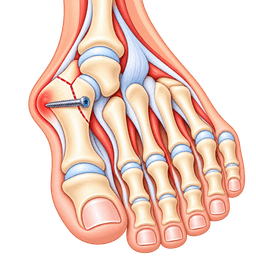
The ball of the foot is formed by the heads of five metatarsal bones. Between neighbouring heads, a ligament called the deep transverse metatarsal ligament links the bones together like a cord. Just under that ligament, in the gap between the heads, run a common plantar digital nerve and a small artery.
The nerve then splits to supply the sides of two toes. The third space is the one where this nerve is formed from two branches (one from the medial and one from the lateral plantar nerve), so it is thicker and less mobile, and this is thought to be why it is the usual site.
What changes in Morton's neuroma?
When the toes are bent upward, as in a high heel or while pushing off in running, the nerve is pulled up against the sharp edge of the ligament. Repeated pinching leads to swelling around the nerve and then thickening of its protective sheath (fibrosis). The nerve can measure 5 mm or more in diameter on ultrasound, compared with a thin thread when healthy.
A swollen nerve is more sensitive and gets pinched more easily, so a cycle forms. A fluid sac (bursa) beside the nerve may add to the squeeze.
Why is the pain felt in the toes?
The nerve carries touch and pain signals for the facing sides of the third and fourth toes. When it is irritated, the brain reads that signal as burning, buzzing or numbness in those toes, even though the problem sits in the ball of the foot.
Symptoms & causes
Morton's neuroma symptoms and causes
Common symptoms
- Burning or sharp pain in the ball of the foot, usually behind the third and fourth toes, that builds as you walk or stand.
- A feeling of standing on a pebble, a fold in your sock or a small marble under the front of the foot.
- Tingling, buzzing or pins and needles that spread into the third and fourth toes, and sometimes the nearby toes as well.
- Numbness in the facing sides of two toes, which may feel like the toes are asleep or covered by a thin glove.
- Pain that is worse in tight, narrow or high-heeled shoes and often eases within minutes of taking the shoes off.
- Relief when you massage the ball of the foot, since pressing on the area spreads the bones and frees the nerve.
- A clicking or popping sensation between the toes when you press the forefoot from the sides, called Mulder's click.
- Cramping or a sense that the toes want to curl, especially at the end of a long day on your feet.
- Pain that wakes some people at night or follows long periods of kneeling, squatting or standing on tiptoe.
- Symptoms that begin gradually over weeks or months and slowly become more frequent, rather than starting suddenly after an accident.
Causes and risk factors
- High heels: raising the heel pushes weight onto the forefoot and bends the toes upward, which stretches the nerve across the ligament.
- Tight or narrow shoes: a snug toe box squeezes the metatarsal heads together and compresses the nerve in between.
- Repeated impact: running, jumping and racquet sports load the ball of the foot and can irritate the nerve over time.
- Foot shape: flat feet, a high arch, bunions and hammertoes alter how weight falls across the forefoot and can narrow the space around the nerve.
- Past injury or surgery: scar tissue or swelling in the forefoot can trap the nerve.
- Jobs that need kneeling or crouching: these hold the toes bent back for long periods and tension the nerve.
- Tight calf muscles: stiff calves push more load onto the front of the foot with every step.
- Space-occupying lumps: a bursa, ganglion cyst or other swelling between the bones can press on the nerve.
Types
Types and stages of Morton's neuroma
Morton's neuroma is described by where it sits and how long it has been present rather than by formal grades. These details guide what treatment is realistic.
Which web space is involved?
Most cases arise in the third web space, between the third and fourth toes, which accounts for the large majority. The second space, between the second and third toes, is the next most common. Occurring in the first or fourth space is rare and makes doctors look harder for another cause. Sometimes two spaces are painful at once, which is worth recognising because the plan may change.
How is the condition staged in practice?
There is no universal staging scale, but surgeons commonly think in three broad phases, as shown below. The phase shows how likely it is that simple measures will be enough.
| Phase | What you notice | Typical approach |
|---|---|---|
| Early irritation | Intermittent tingling or pain in tight shoes, fully gone at rest | Wider shoes, pad, activity change |
| Established neuroma | Regular burning, a pebble feeling, pain on most walks | Pad, orthotic, injection, physiotherapy |
| Chronic or recurrent | Constant pain and numbness, changes after previous treatment | Specialist review, nerve surgery or revision |
What is a recurrent or stump neuroma?
After a nerve is cut, the end can form a new tender lump called a stump neuroma. This is a recognised cause of pain that returns after surgery. Recurrent pain usually needs a careful look for the cause, including whether the wrong space was operated on or whether another condition was present all along.
Why does the classification matter?
The earlier the phase, the better non-surgical care is likely to work. In a chronic neuroma, the nerve has often changed permanently, and conservative care may only reduce symptoms. A clear picture of the phase also helps set realistic expectations for any injection or operation.
Diagnosis
How is Morton's neuroma diagnosed?
Morton's neuroma is usually diagnosed from your story and a hands-on examination, with imaging used to confirm the nerve and exclude other causes. A good clinician can often make the diagnosis within one consultation.
What will the doctor ask?
You will be asked where the pain sits, what it feels like, which shoes bring it on and what relieves it. The classic clues are burning in the ball of the foot, tingling in two toes and prompt relief when the shoe is removed. The doctor will also ask about work, sport, heels, and any previous forefoot injury or surgery.
What does the examination find?
The doctor presses between the metatarsal heads from the sole side and checks for sharp tenderness in the web space. In the Mulder test, the forefoot is squeezed from the sides while the web space is pressed, and a click with reproduction of the pain suggests a neuroma. The doctor also checks the toe joints, the arch, the skin sensation and the range of ankle motion, and examines the other foot for comparison.
Is imaging needed?
Imaging is not always required, but it helps. Ultrasound, performed by an experienced operator, shows a rounded, low-signal mass between the metatarsal heads, often 5 mm or more, and can be done at the same visit. MRI is a good alternative and is useful when several spaces are painful or the diagnosis is unclear. Plain X-rays do not show the nerve, yet they are taken to rule out stress fractures, arthritis and bone shape problems.
Can a diagnostic injection help?
Placing a small amount of local anaesthetic into the web space and seeing whether the pain stops for a while is both diagnostic and therapeutic. If the pain disappears, it supports the diagnosis.
What should you prepare for a remote review?
Prepare a short written timeline, a photo of the footwear you wear most often, any ultrasound or MRI reports with the images, and weight-bearing X-rays if you have them. Add notes about previous injections and their effect. Our medical record review guide explains how files are shared and checked.
Tests you may have
- Clinical squeeze test (Mulder's test): pressing the forefoot from the sides while feeling the web space can reproduce the click and the burning pain of a neuroma.
- Web space palpation: firm pressure from the sole side between the metatarsal heads finds the exact tender point.
- Ultrasound: shows a rounded mass between the metatarsal heads and measures its size, and it can also reveal a fluid sac.
- MRI of the forefoot: confirms the mass in doubtful cases and screens for stress fracture, joint inflammation or other lumps.
- Weight-bearing foot X-rays: do not show the nerve but exclude stress fractures, arthritis and metatarsal alignment problems.
- Diagnostic local anaesthetic injection: temporary relief of pain after an injection into the web space supports the diagnosis.
- Nerve conduction studies or blood tests: used only when a wider nerve problem, diabetes or an inflammatory disease is suspected.
Look-alikes
Conditions that can feel like Morton's neuroma
Pain in the ball of the foot has many causes, and Morton's neuroma is one of several that need to be told apart. The table below shows the most common look-alikes.
| Condition | How it differs from Morton's neuroma | How doctors tell |
|---|---|---|
| Metatarsalgia | Dull, aching pain under the metatarsal heads without tingling | Pain is under the joint, not between the toes; calluses are common |
| Plantar plate tear | Pain at the base of the second or third toe with a drifting toe | Drawer test, ultrasound or MRI |
| Stress fracture of a metatarsal | Localised bone pain that is worse with impact and builds after a sudden rise in training | X-ray changes after 2 to 3 weeks, or an early MRI |
| Capsulitis of the MTP joint | Swelling and tenderness of the joint at the base of the toe | Pain on moving the joint, not on squeezing the web space |
| Tarsal tunnel or peripheral neuropathy | Numbness across several toes or both feet, often burning at night | Nerve tests, diabetes screen, tapping over the tarsal tunnel |
| Lumbar nerve root problem | Back or leg pain with numbness in a pattern that follows a nerve root | Back examination, straight leg raise, spine MRI |
Why is it often mistaken for something else?
Forefoot pain is common, and several conditions can overlap. A person may have a neuroma together with a bunion, a hammertoe or an inflamed joint. If treatment aimed at one cause fails, it is reasonable to look for the other. In the neuroma, the pain is characteristically in the web space and spreads to the toes, while joint pain is felt at the joint.
When does a mimic need urgent attention?
Numbness that spreads, sudden weakness of the foot, or a cold pale foot is not a neuroma and needs prompt medical attention. Please also read the related pages on hammertoe and plantar fasciitis, which share the same area of the foot.
Non-surgical
Non-surgical treatment for Morton's neuroma
Most people with Morton's neuroma improve without surgery, and treatment starts with taking pressure off the nerve. The earlier these steps begin, the better they tend to work.
Which footwear changes come first?
Wide-fitting shoes with a roomy toe box are the foundation. Look for a low, broad heel, a firm sole that does not bend at the ball of the foot, and a soft upper. A shoe with a mild rocker sole lets the foot roll through the step without bending the toes. Avoid heels higher than about 4 cm (1.5 inches) and narrow pointed fronts. Many people notice a difference within 2 to 4 weeks.
How do pads and insoles work?
A metatarsal pad is a small dome placed just behind the ball of the foot, not under it. It spreads the metatarsal heads and lifts the load off the nerve. Placement is critical, so a podiatrist or physiotherapist often positions it. Custom or off-the-shelf insoles that support the arch can help if flat feet add to the strain.
Can physiotherapy and activity changes help?
Physiotherapy works on calf flexibility, foot muscle strength and walking or running patterns. Short-term changes such as swapping running for swimming or cycling while the nerve settles are helpful. Avoiding hill work and kneeling positions that load the toes can be enough for early cases. Gentle forefoot massage and toe spreading exercises can relieve symptoms during the day.
Which medicines are used?
Simple pain relievers and anti-inflammatory medicines may take the edge off flare-ups, although they often have limited effect on nerve pain. Some doctors prescribe a nerve pain medicine for a short trial in stubborn cases. Always check with a doctor or pharmacist about suitability.
What does a Morton's neuroma injection do?
A Morton's neuroma injection places a corticosteroid, sometimes with local anaesthetic, into the web space, usually guided by ultrasound. It reduces swelling around the nerve and brings relief for weeks to months in many people, although relief may fade. Doctors usually limit the number of injections, often to 2 or 3, because repeated steroid can thin the fat pad or damage nearby joints and ligaments.
Other injections, such as alcohol sclerosing injections, are used in some centres, and evidence for them is limited.
Which other non-surgical treatments exist?
Radiofrequency ablation and cryotherapy (freezing the nerve) are minimally invasive options that damage the nerve fibres to stop pain signals. They can help people who are not suitable for surgery, but the evidence base is smaller than for standard surgery, so ask about the results the clinic can show.
Self-care
Exercises and self-care for Morton's neuroma
Good self-care for Morton's neuroma means protecting the forefoot, keeping the calf and foot muscles supple and noticing what triggers the pain. Check with your doctor or physiotherapist before starting, especially if you also have diabetes or circulation problems.
Which daily habits reduce flare-ups?
Swap into roomy shoes for the walk to work and for long days on your feet. Take your shoes off for a few minutes when the burning starts and massage the ball of the foot. Rest the foot with the toes pointing up, and apply an ice pack wrapped in a cloth for 10 minutes if it is sore. Keep a simple diary of the shoes, activities and distances that set it off.
What exercises are safe to try?
- Calf stretch against a wall: hold for 30 seconds, 3 times each side, once or twice daily.
- Toe spreading: sit with the foot flat and spread the toes wide, hold for 5 seconds, 10 repetitions.
- Short-foot exercise: draw the ball of the foot towards the heel without curling the toes, hold for 5 seconds, 10 repetitions.
- Rolling a small ball or frozen bottle under the arch for 2 minutes, with only light pressure.
Stop any exercise that sharpens the burning, and build up slowly over 4 to 6 weeks.
How can you stay active?
Choose low-impact activity while the pain settles: swimming, cycling or rowing keep your fitness up without repeated loading of the forefoot. If you run, shorten sessions, run on softer surfaces and wear a wide-toe-box trainer. Return gradually, adding no more than about 10% to the weekly distance.
What should you avoid?
Avoid tight shoes, high heels and long spells on tiptoe. Do not cut away at calluses yourself, and avoid walking barefoot on hard floors if it triggers pain. Avoid repeated, hard foot massage directly on the swollen nerve, which can inflame it more. If you notice constant numbness, see a clinician rather than waiting.
These habits do not remove the thickened nerve, but they can bring it into the quiet phase.
Check with your doctor or physiotherapist before starting new exercises, and stop any movement that causes sharp pain.
Treatment
Morton's neuroma treatment options
Surgery for Morton's neuroma is an option when the pain stays disabling after non-surgical treatment, and the operation is short and usually done as a day case. The two main choices are to release the pressure on the nerve or to remove the nerve.
What is neurectomy?
Neurectomy is removal of the thickened section of nerve. The surgeon makes a cut either on the top of the foot (dorsal approach) or on the sole (plantar approach) and takes out the affected nerve segment along with its swelling. The two toes lose feeling on their facing sides, which most people accept in exchange for the burning pain going away. It is the classic operation and gives lasting relief to most patients, although a minority are left with some pain or a stump neuroma.
What is nerve decompression?
In decompression, the surgeon cuts the tight deep transverse metatarsal ligament but leaves the nerve in place. This lets the nerve slide freely and usually keeps feeling in the toes. It can be done through a small incision or by keyhole technique, and it suits people with milder disease and a nerve that is not hugely enlarged. The surgeon may also use it alongside other forefoot procedures.
Where does forefoot surgery come in?
Most foot surgeons plan a neuroma operation within the wider field of forefoot surgery, since a bunion, hammertoe or joint problem can coexist. If you travel for the operation, our forefoot surgery in turkey page describes the pathway, and the forefoot surgery cost guide explains how pricing is shown.
How do the options compare?
| Option | What it does | Main trade-off |
|---|---|---|
| Dorsal neurectomy | Removes the nerve segment from the top of the foot | Permanent numbness of two toe sides; stump neuroma risk |
| Plantar neurectomy | Removes the nerve from the sole | Tender scar on the weight-bearing area; longer off-loading |
| Decompression (ligament release) | Frees the nerve and keeps it intact | Pain may remain if the nerve is very enlarged |
| Ablation or cryotherapy | Destroys the nerve fibres without a larger cut | Less long-term evidence, can recur |
What are the usual steps?
The operation takes about 20 to 40 minutes. It is done under a local anaesthetic ankle block with or without sedation, and you usually go home the same day. A bandage and a protective shoe are worn for about 2 weeks. The surgeon also tests the neighbouring spaces and may treat a coexisting problem at the same time.
When surgery is considered
Surgery for Morton's neuroma makes sense when the pain persists after a proper trial of shoes, padding and at least one injection, and the pain limits normal life. Most surgeons wait about 3 to 6 months of well-planned conservative care before suggesting an operation.
What points favour an operation?
- Burning or sharp pain that continues to interfere with walking, work or sleep despite wide shoes and a pad.
- An injection that helped only briefly, or two or three injections that no longer work.
- An ultrasound or MRI that confirms a neuroma of 5 mm or more, in the web space that matches your symptoms.
- Relief that follows a diagnostic injection, which suggests surgery is aimed at the right place.
- A wish to return to running, dancing or a physical job that the pain currently prevents.
When should you hold back?
If the pain does not match the usual pattern, if an ultrasound shows no mass, or if there are signs of a wider nerve or spine problem, an operation on the foot may not help. Smoking, poorly controlled diabetes and poor circulation raise the risk of wound problems, so these should be addressed first. If your pain eased after a diagnostic injection, you have a good chance of benefit from surgery.
Which questions should you ask?
- Which operation do you suggest for me, and why that one over the alternatives?
- Will I lose feeling in my toes, and which parts?
- What proportion of your patients are free of pain, and how do you measure it?
- Are you treating anything else in my forefoot at the same time?
- When can I drive, return to work and wear ordinary shoes?
If you want an independent view, you can send your records for a free case review before committing.
Procedures
Procedures that may treat Morton's neuroma
Costs
Morton's neuroma treatment cost in Turkey
| Procedure | Turkey package | US self-pay | Saving |
|---|---|---|---|
| Forefoot Surgery | $2,500 – $5,000 | $13,800 | ~73% |
Packages are contracted partner prices with validity dates; benchmarks are source-backed estimates. Open a cost guide for the full country comparison.
In Turkey
Treating Morton's neuroma in Turkey
Treating Morton's neuroma in turkey is practical for people who need planned, non-urgent surgery and have a clear diagnosis. The operation is brief and usually a day case, which makes the trip fairly short.
When does Morton's neuroma treatment in turkey make sense?
Forefoot surgery for Morton's neuroma in turkey is planned as a short trip. It suits adults who have already tried wide shoes, padding and injections without lasting relief, and who have an ultrasound or MRI that supports the diagnosis. It may be especially useful when you also need another forefoot problem treated. See our overview of orthopedic care in turkey and the why turkey guide for the wider picture.
What does the pathway look like?
- Send your records: history, imaging reports and images, and photos of your feet and shoes.
- Remote review: a foot surgeon looks at the case, asks for any missing information and says whether surgery is likely to help.
- Written plan: it names the operation, the anaesthetic, the length of stay and the follow-up schedule.
- Arrival and surgery: you are examined on arrival, and the operation is done as a day case or with one night in hospital.
- Early review: the wound is checked at around 10 to 14 days, usually while you are still in turkey.
- Home care: stitches, scar care and progress checks are handled with a local clinician, as in our follow-up guide.
What should you send?
Include the ultrasound or MRI report and the images on disc or as files, your list of medicines, the details and dates of previous injections, and any other foot or spine diagnoses. Photos of your usual shoes can help. Use our free case review form to upload them, and read how the plan is built in the treatment planning guide.
How should you check the surgeon and hospital?
Ask whether the hospital is accredited, whether the surgeon is a specialist in foot and ankle surgery, and how many neuroma operations they do in a year. Ask which technique they use and why, how they handle a recurring neuroma and who you contact after you leave. The questions to ask before surgery abroad guide has a ready checklist.
What about timing and travel?
Plan about 5 to 7 days in turkey, which covers the surgery and the first wound review. A short flight is often allowed after a few days if swelling is controlled, but confirm this with the surgeon, and see the flying after surgery guide. A companion can carry bags and help the first few days.
When should you not travel?
Do not travel for surgery if you have an infected or ulcerated foot, uncontrolled diabetes or a pain that has not been properly diagnosed. If the pain began suddenly after an injury, get an examination for a fracture first. For the pricing method see the forefoot surgery cost guide.
Complications
Complications of Morton's neuroma
Morton's neuroma does not threaten your health, but without care it can wear you down, and surgery has its own set of risks. Knowing both helps you decide calmly.
What can happen if it is left untreated?
The nerve can become more thickened and sensitive over time, so pain comes sooner and lasts longer. Many people change how they walk to avoid the sore spot, which can strain the knee, hip or back, or bring on pain in another part of the foot. Numbness in the toes may become constant. A few people give up walking, work or sport because of the pain.
What are the risks of treatment?
Non-surgical treatments are safe for most people, but steroid injections can occasionally thin the fat pad under the ball of the foot, cause toe joint instability or lighten the skin. Surgery is generally successful, and the main risks are these:
- Permanent numbness in the skin on the facing sides of two toes after neurectomy, which is expected.
- Persistent or recurring pain, which affects a minority of patients and may be due to a stump neuroma or a missed diagnosis.
- A tender scar, especially if the cut is made on the sole of the foot.
- Wound infection or delayed healing, more likely in smokers and people with diabetes.
- Swelling and stiffness of the forefoot that can last for 3 months or more.
- Blood clots, which are rare after a short toe operation, but possible if you are immobile.
How can complications be reduced?
A confirmed diagnosis, the right web space and a surgeon who has done this operation often are the best protections. Stop smoking before surgery, control blood sugar, keep the foot raised and keep to your weight-bearing instructions. Report spreading redness, discharge, fever or increasing pain promptly. If symptoms come back, an experienced team can decide whether a revision operation or a different approach is sensible.
Urgent care
When to seek urgent care for Morton's neuroma
- Constant severe pain with redness, heat and swelling of the forefoot: this may be infection or a fracture, so get same-day medical assessment.
- Numbness or burning that spreads across the whole foot or into both feet: see a doctor soon, since a wider nerve problem or diabetes may be responsible.
- A cold, pale or blue foot with pain: seek urgent care, because the blood supply may be reduced.
- New weakness, foot drop or back pain with leg numbness: see a doctor promptly, as this can point to a spinal nerve problem.
- Pain that began suddenly after an injury or a jump, with bruising: arrange an X-ray to check for a stress fracture or break.
- After surgery, fever, pus, wound opening or spreading redness: contact your surgical team the same day.
- After surgery, a hot, swollen calf or sudden breathlessness: treat as an emergency and seek care at once.
Prevention
How to lower your risk of Morton's neuroma
You cannot always prevent Morton's neuroma, but you can lower the pressure on the forefoot that causes it. Prevention is mostly about footwear, load and foot strength.
Which shoes protect the nerve?
Choose shoes with a wide, deep toe box, a low heel and a sole that is firm enough to stop the front of the foot bending sharply. Fit them while standing, and make sure your toes can spread. If you must wear heels, keep them for short occasions and swap into flat shoes for walking. A heel above 5 cm (2 inches) throws large forces onto the ball of the foot.
How should you manage sport and work?
Runners should increase mileage slowly, replace worn shoes every 500 to 800 km, and vary surfaces. Dancers and climbers, whose sport requires tight shoes or tiptoe positions, can build in rest periods and use a metatarsal pad when allowed. If you kneel or crouch at work, take short breaks to straighten the toes and shake out the feet.
What strengthens the foot?
Strong calves and foot muscles share the load of walking and take pressure off the ball of the foot. The stretching and short-foot exercises in the self-care section are a good routine. Keeping a healthy body weight also reduces load through the forefoot with each step.
Which related problems should you treat early?
Bunions, hammertoes and flat feet alter forefoot loading and are linked with neuroma. Seeing a foot specialist about these early may help prevent a second problem. You can read more on flat feet and bunions, or browse the foot and ankle section for other conditions.
What cannot be prevented?
Inherited foot shape, anatomy of the nerve and some injuries cannot be changed. Many people with these risk factors never develop a neuroma, and many who do respond well to simple steps. If you notice early tingling that settles when you remove your shoes, act then, since that is the stage when change is most effective.
Outlook
Living with Morton's neuroma: outlook and recovery
The outlook for Morton's neuroma is good: most people reach a comfortable foot with shoe changes, padding and injections, and surgery gives lasting relief to most of those who need it. Early treatment gives the best chance of avoiding an operation.
What is the natural course?
Without treatment, symptoms often come and go. Some people have long quiet spells when they use better shoes, while others find the pain increases over a year or two. A neuroma does not usually disappear on its own, but it can stop being a problem when the pressure is removed.
What results can you expect after non-surgical care?
Many people gain useful relief from footwear changes and a metatarsal pad within 4 to 8 weeks. An injection may help for weeks to months, and some people are comfortable for years afterwards. If symptoms return, you can repeat the steps or discuss surgery.
What is recovery like after surgery?
You walk on the heel or in a protective shoe straight after the operation. The foot is raised for the first 2 weeks, and stitches are removed at about 10 to 14 days. Swelling can last 3 months, and full comfort in normal shoes often takes 6 to 12 weeks.
| Time after surgery | What to expect |
|---|---|
| First 2 weeks | Raised foot, protective shoe, wound check, stitches out |
| 2 to 6 weeks | Walking in a roomy shoe, gentle toe exercises, scar massage |
| 6 to 12 weeks | Return to most activity, driving and desk or standing work as allowed |
| 3 to 6 months | Swelling settles, running and sport are usually possible, scar softens |
When can you return to work and sport?
Desk work is often possible within about 1 to 2 weeks, standing jobs in 4 to 6 weeks, and running in about 8 to 12 weeks, depending on your recovery. Your surgeon will advise on driving, which depends on the foot and your pain control. Our rehabilitation guide describes what a good plan includes.
How long do results last?
Most people who have a neurectomy remain satisfied years later, though a minority continue to have some pain, and a few need a second operation. Staying in sensible shoes remains important. The goal is a foot that lets you work, walk and play with little or no pain.
Surgeons
Specialists who treat Morton's neuroma
FAQ
Morton's neuroma: frequently asked questions
What is Morton's neuroma?
What does Morton's neuroma feel like?
What causes Morton's neuroma?
Can Morton's neuroma go away on its own?
How is Morton's neuroma diagnosed?
Does a Morton's neuroma injection work?
What shoes are best for Morton's neuroma?
When is surgery needed for Morton's neuroma?
Will I lose feeling in my toes after Morton's neuroma surgery?
Is Morton's neuroma surgery in turkey safe?
How long should I stay in turkey after neuroma surgery?
Can Morton's neuroma come back after surgery?
Sources
Sources for this Morton's neuroma guide
Peer-reviewed guidance and institutional sources used to write and review this page.
- 01Morton's Neuroma
American Academy of Orthopaedic Surgeons (OrthoInfo), 2022
https://orthoinfo.aaos.org/en/diseases--conditions/mortons-neuroma/
- 02Morton's neuroma
Mayo Clinic, 2022
https://www.mayoclinic.org/diseases-conditions/mortons-neuroma/symptoms-causes/syc-20351935
- 03
- 04Morton's Neuroma
American Orthopaedic Foot & Ankle Society (FootCareMD), 2022
https://www.footcaremd.org/conditions-treatments/forefoot/mortons-neuroma
- 05
- 06